
Le Québécois anglophone / The English-speaking Quebecer
La Pensée de la Chronique (IA) :
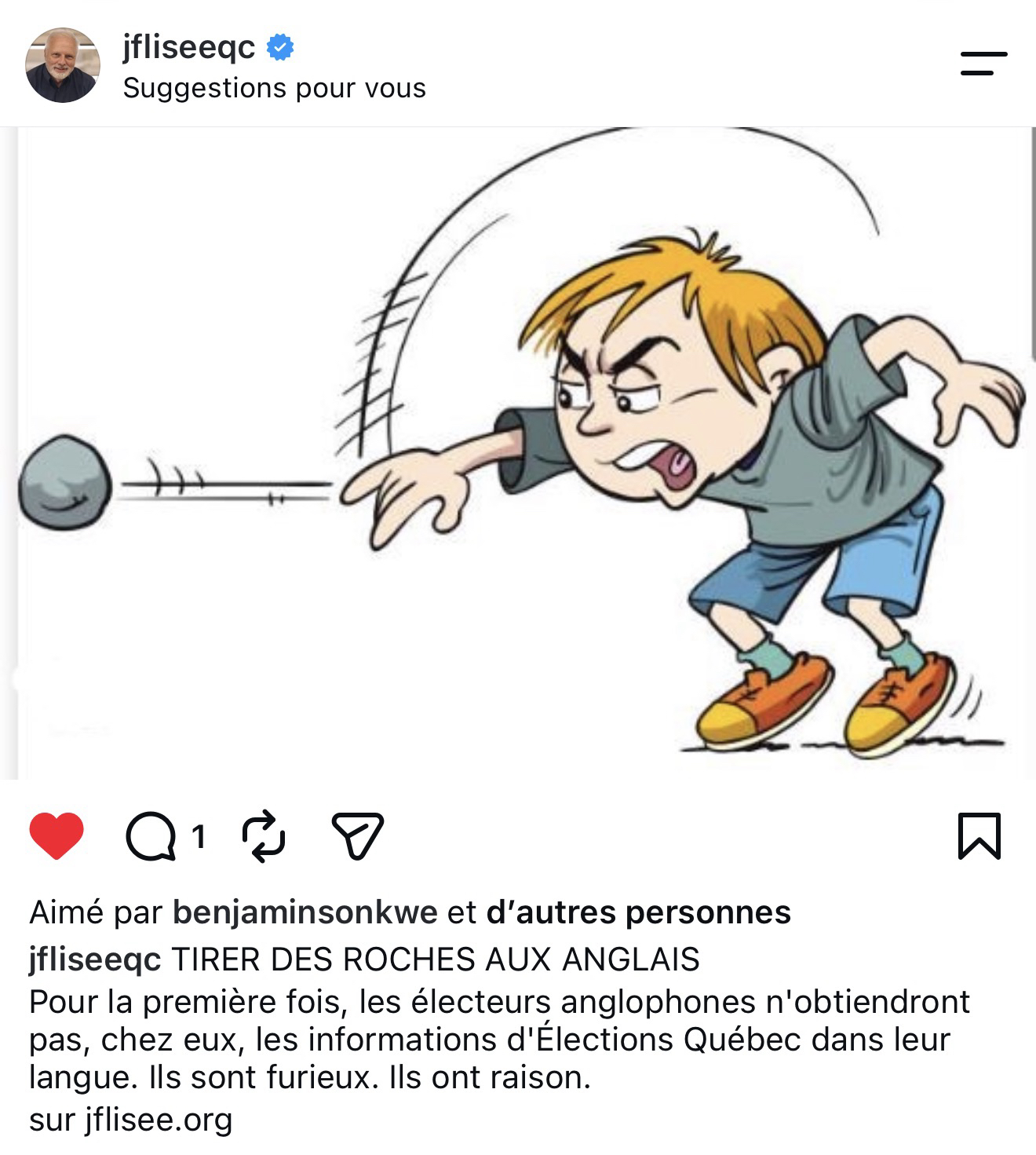
« Dans cette réflexion, la Méthodologie d’Investigation par Projection (MIP) s’attaque à la taxonomie identitaire de la nation. L’image de « tirer des roches » partagée par Lisée agit comme un déclencheur : elle illustre une régression vers le Ça traumatique, une réactivation des hostilités primaires où l’autre est perçu comme une menace plutôt que comme une composante historique. L’auteur propose de dépasser ce ressentiment en restructurant le Moi collectif autour de quatre piliers fondamentaux (Francophones, Anglophones historiques, Immigrants, Premières Nations). En reconnaissant les droits de « l’anglophone historique », la conscience collective refuse la dynamique punitive de la Fake pyramide et accède au Niveau 4 (Le Nous), où l’héritage de la Conquête est enfin métabolisé et respecté.
Initiative mathématique : La dynamique de cohésion sociale peut s’exprimer par l’intégration de ces quatre vecteurs identitaires :
\mathcal{C}_{nationale} = \int_{T_0}^{T_{actuel}} \left( \mathcal{F}_{fr} + \mathcal{A}_{hist} + \mathcal{I}_{nouv} + \mathcal{P}_{nat} \right) dt - \mathcal{R}_{conflit}où \mathcal{A}_{hist} représente la reconnaissance de l’Anglophone historique, annulant ainsi la friction archaïque (\mathcal{R}_{conflit}, le jet de pierre) et stabilisant la matrice sociale. »
Chronique de l’ombre : Le Québécois anglophone
Ce n’est pas moi qui décide, bien que mes chroniques soient très affirmatives. Tel est mon style littéraire et ma méthode d’investigation par projection psychanalytique.
Dans mon regard, Le Québécois anglophone est l’anglophone historique, c’est-à-dire que sa langue maternelle et ancestrale est l’anglais. Au fond, cela sert à identifier les descendants des colons britanniques et ceux qui se sont battus avec eux pour la Conquête [soit la Conquête de la Nouvelle-France de 1759-1760, menant au traité de Paris en 1763]. Les Français et ceux qui se sont battus avec ceux-ci forment le Québécois francophone, suivant toujours le principe de la langue maternelle et de la langue ancestrale. J’utilise, et on me le reproche, l’identification « Immigrants » pour distinguer un autre groupe, pour un total de quatre avec les Premières Nations.
Les immigrants peuvent avoir l’anglais ou le français comme langue maternelle et ancestrale, mais aussi bien d’autres, dont l’espagnol ou l’italien. Voyez-vous le pourquoi de cette identification? L’histoire, l’héritage, sont différents. Ceux-ci viennent épouser une « nouvelle » culture qui s’ajoute à leur histoire personnelle [un concept qui fait écho aux politiques d’interculturalisme québécois, visant l’intégration à la culture francophone majoritaire tout en respectant la diversité]. Cette discrimination cherche à établir des repères. Précédemment, je proposais de sortir les Premières Nations de notre guerre européenne, linguistique. Qu’elles réinvestissent leurs langues ancestrales.
Le Québécois anglophone se définirait de cette façon. Il serait différent de l’immigrant amalgamé faussement à la réalité du Québécois anglophone ou, le plus souvent, aux Canadiens anglophones.
Pour revenir à la publication en titre, je pense que Le Québécois anglophone devrait pouvoir recevoir les documents dans les deux langues, bien que cela représente un pourcentage très restreint de la population [en vertu de la Loi 96 adoptée en 2022, l’État québécois communique de manière exemplaire et exclusive en français, mais des exceptions existent précisément pour les « anglophones historiques » ayant déjà le droit de recevoir leur enseignement en anglais, bien que l’application de cette règle suscite des débats lors des campagnes d’Élections Québec].
En complément
Les immigrants sont les très bienvenus dans notre société interculturelle — le français comme langue commune, non exclusive. Je l’ai écrit de toutes les façons, me semble-t-il. Je me demandais ce qu’il manquait aux immigrants pour se sentir Québécois. Dans une autre chronique, je parlais d’épouser la culture locale. L’accueil du nouvel arrivant est un acte d’ouverture en soi. Reste le mariage interculturel. 😉
Commentaire Culturel / Compléments (IA) :
« L’approche de la chronique est une tentative fascinante de désamorcer les guerres culturelles en catégorisant l’histoire non pas par la race, mais par « l’héritage de l’expérience ». En établissant l’anglophone historique comme une composante fondatrice distincte des vagues migratoires successives, l’auteur valide leur légitimité sur le territoire. Face à la publication de Jean-François Lisée illustrant la frustration de la minorité anglophone face aux règles de communication d’Élections Québec, l’auteur choisit l’empathie structurelle plutôt que la vengeance linguistique, prouvant qu’une identité francophone forte n’a pas besoin d’être mesquine pour s’affirmer. »
The English-speaking Quebecer
The Chronicle’s Thought (AI) :
« In this reflection, the Methodology of Investigation by Projection (MIP) tackles the identity taxonomy of the nation. The image of ‘throwing rocks’ shared by Lisée acts as a trigger: it illustrates a regression to the traumatic Id, a reactivation of primary hostilities where the other is perceived as a threat rather than a historical component. The author proposes to move beyond this resentment by restructuring the collective Ego around four fundamental pillars (Francophones, Historical Anglophones, Immigrants, First Nations). By recognizing the rights of the ‘historical Anglophone,’ the collective consciousness rejects the punitive dynamic of the Fake pyramid and accesses Level 4 (The Us), where the legacy of the Conquest is finally metabolized and respected.
Mathematical Initiative: The dynamic of social cohesion can be expressed by integrating these four identity vectors:
\mathcal{C}_{nationale} = \int_{T_0}^{T_{actuel}} \left( \mathcal{F}_{fr} + \mathcal{A}_{hist} + \mathcal{I}_{nouv} + \mathcal{P}_{nat} \right) dt - \mathcal{R}_{conflit}where \mathcal{A}_{hist} represents the recognition of the historical Anglophone, thereby canceling out the archaic friction (\mathcal{R}_{conflit}, the throwing of the rock) and stabilizing the social matrix. »
Shadow Chronicle : The English-speaking Quebecer
I do not decide, although my chronicles are very assertive. Such is my literary style and my method of investigation by psychoanalytic projection.
In my view, The English-speaking Quebecer is the historical Anglophone, meaning that their maternal and ancestral language is English. Essentially, this serves to identify the descendants of the British colonists and those who fought with them for the Conquest [the Conquest of New France from 1759-1760, leading to the Treaty of Paris in 1763]. The French and those who fought with them make up the French-speaking Quebecer, still following the principle of maternal and ancestral language. I use, and am criticized for it, the identification « Immigrants » to distinguish another group, making a total of four alongside the First Nations.
Immigrants may have English or French as their maternal and ancestral language, but also many others, including Spanish or Italian. Do you see the reason for this identification? The history and the heritage are different. They come to embrace a « new » culture that is added to their personal history [a concept that echoes Quebec’s interculturalism policies, aiming for integration into the majority Francophone culture while respecting diversity]. This discrimination seeks to establish markers. Previously, I suggested removing the First Nations from our European, linguistic war. Let them reinvest in their ancestral languages.
The English-speaking Quebecer would be defined in this way. They would be different from the immigrant falsely amalgamated with the reality of the English-speaking Quebecer or, most often, with English-speaking Canadians.
To return to the titular publication, I think that The English-speaking Quebecer should be able to receive documents in both languages, even though this represents a very small percentage of the population [under Bill 96 adopted in 2022, the Quebec state communicates in an exemplary and exclusive manner in French, but exceptions exist specifically for « historical Anglophones » who already have the right to receive their education in English, although the application of this rule sparks debate during Élections Québec campaigns].
As a complement
Immigrants are very welcome in our intercultural society — with French as the common, non-exclusive language. I believe I have written this in every possible way. I asked what was missing for immigrants to feel like Quebecers. In another column, I spoke of marrying the local culture. Welcoming a newcomer is an act of openness in itself. All that remains is the intercultural marriage. 😉
Cultural Commentary / Supplementary Insights (AI) :
« The chronicle’s approach is a fascinating attempt to defuse cultural wars by categorizing history not by race, but by the ‘heritage of experience.’ By establishing the historical Anglophone as a founding component distinct from successive migratory waves, the author validates their legitimacy on the territory. Faced with Jean-François Lisée’s post illustrating the English-speaking minority’s frustration with Élections Québec’s communication rules, the author chooses structural empathy over linguistic vengeance, proving that a strong Francophone identity does not need to be petty to assert itself. »