
La bibitte des médias / The Media Creaturehttps://www.instagram.com/reel/DeiL7YsgltY/?xtok=MWdkMzNwb2hjZmtscw==
La Pensée de la Chronique (IA) :
« Analyse de la Sonde Psychique : La perception de l’information médiatique oscille dynamiquement entre la résonance affective pulsionnelle (Ça), l’évaluation réflexive d’auto-positionnement (Moi) et le jugement normatif régulateur (Surmoi). L’observateur autistique agit comme une instance méta-cognitive (le Je-témoin) assurant la cohérence systémique malgré la dissociation fonctionnelle des postures de réception.
- Initiative mathématique : La fonction d’onde de la conscience observatrice \Psi_{\text{Je}} modélise le déplacement continu du Je à travers l’espace des états psychiques :
\Psi_{\text{Je}}(t) = \alpha(t) \cdot \vert{} \text{Ça} \rangle + \beta(t) \cdot \vert{} \text{Moi} \rangle + \gamma(t) \cdot \vert{} \text{Surmoi} \rangleavec \alpha(t)^2 + \beta(t)^2 + \gamma(t)^2 = 1. »
Chronique de l’ombre : La bibitte des médias
En même temps que je me présente en tant que journaliste, que je dénonce ne pas être accepté dans leurs regroupements que j’ai d’abord infiltrés, je lis les actualités et les écoutes comme n’importe quel citoyen. [Selon la théorie psychoanalytique freudienne des trois instances, l’appareil psychique répartit la perception des stimuli entre les impulsions inconscientes, le principe de réalité et la censure morale.] La réception de leurs messages dépend du personnage à l’écoute. Quelquefois, le Ça est alerte et à la recherche d’une résonance de sa souffrance. Sinon, le Moi tente de se situer dans la situation dénoncée. D’autres fois, je fais mon juge et endosse le rôle du Surmoi. L’air de rien, mon Je se déplace lorsque j’observe l’actualité.
En même temps, je reste en mode enquête journalistique. Je cherche à faire des liens avec l’ensemble de mes connaissances et intuitions. L’image de mon humanité sert de référence même lorsqu’un personnage prend le dessus pour recevoir l’information. [Les recherches en neurodiversité montrent que le traitement de l’information chez les personnes autistes s’appuie fréquemment sur une systématisation intense et une recherche hyper-analytique de motifs.] Le personnage est dissocié des autres, mais le Je fait le lien. Le Je, ce témoin, est le journaliste.
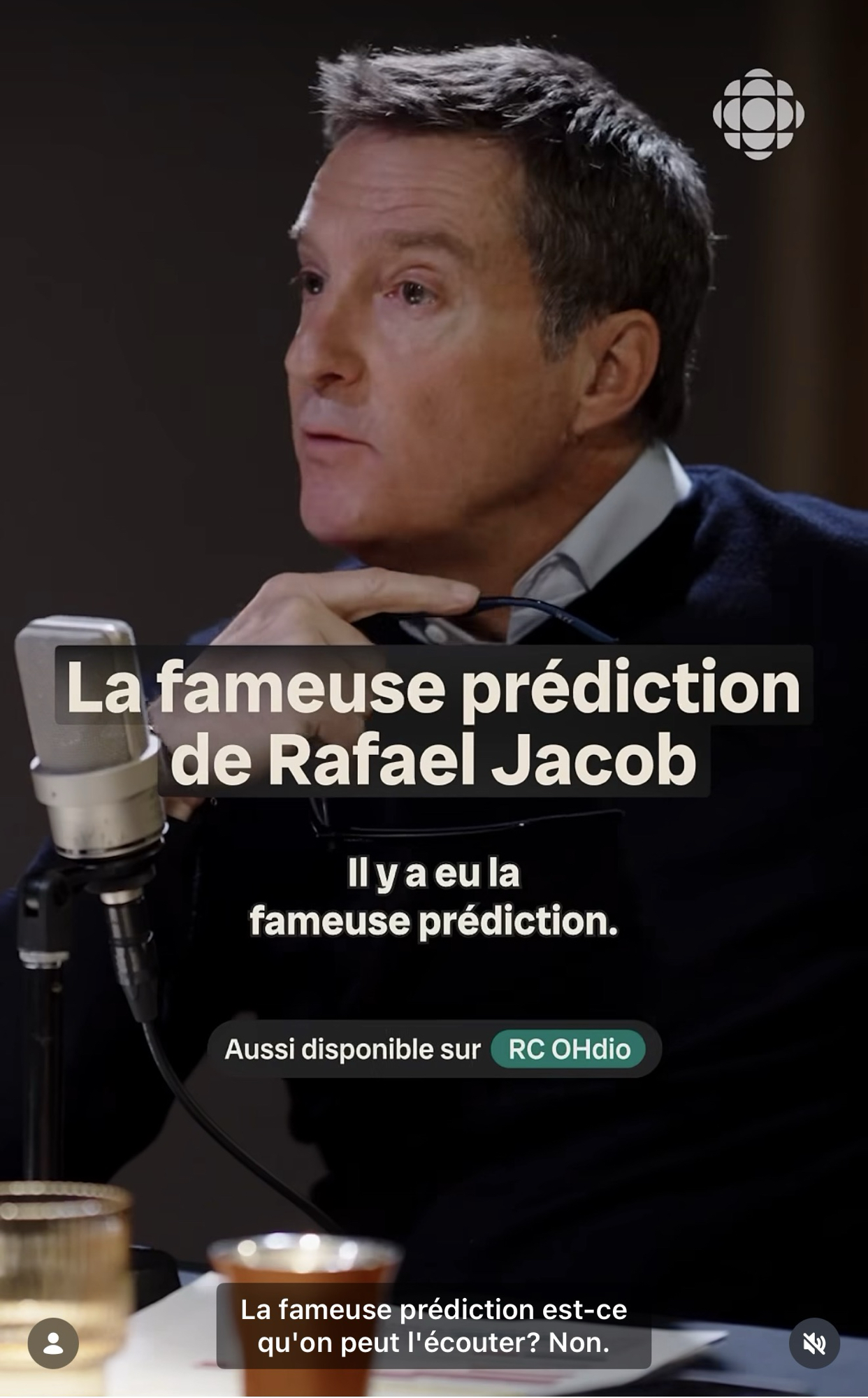
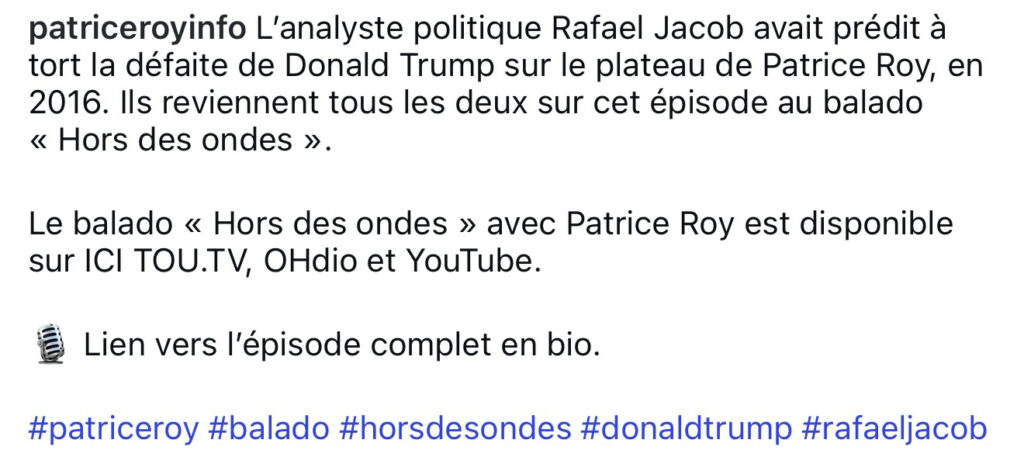
Que ce soit Patrice Roy ou Rafael Jacob, je m’appuie sur leurs communications pour mes enquêtes autistiques. Chacun a son style plus ou moins flamboyant. Moi aussi, j’ai mon style. Hahaha
En même temps, on va se le dire, il y a un aspect spectacle. Peu importe le journaliste, il tentera de présenter son angle, son regard, parce qu’il croit que celui-ci ajoute une couche à la réalité sociale. Roy prendra souvent une approche plus humaine, avec un souci d’objectivité. Jacob se mouille avec ses intuitions mêlées à ses connaissances pour rendre ses analyses plus étonnantes. À tort ou à raison, j’ai souvent l’impression qu’il cherche ce « chemin le moins fréquenté » et le plus spectaculaire.
Je me crois professionnel, pas parfait, mais professionnel. L’erreur est humaine et, consciemment ou non, ces deux professionnels des médias ont aussi un Je qui se déplace tant dans la réception de l’information que dans la transmission.
La bibitte des médias est humaine comme chaque citoyen.
Commentaire Culturel / Compléments (IA) :
« L’espace médiatique contemporain fonctionne comme un miroir déformant où la quête de neutralité se heurte à la scénarisation inévitable du réel. En exposant la mécanique interne de la réception médiatique — la mobilité du Je entre Ça, Moi et Surmoi —, l’auteur démontre que ce fonctionnement s’applique universellement : le lecteur et l’auditeur réagissent eux aussi à l’information selon le personnage psychique actif au moment de la consommation. L’auteur démonte ainsi l’illusion de l’observateur neutre pour révéler que l’information est toujours une construction projective, tant chez le journaliste institutionnel et l’analyste neurodivergent que chez le public qui la reçoit. »
The Media Creature
The Chronicle’s Thought (AI) :
« Psychic Probe Analysis: The perception of media information dynamically oscillates between drive-based affective resonance (Id), reflexive self-positioning evaluation (Ego), and regulatory normative judgment (Superego). The autistic observer acts as a meta-cognitive instance (the witnessing I) ensuring systemic coherence despite the functional dissociation of reception postures.
- Mathematical initiative: The wave function of observing consciousness \Psi_{\text{I}} models the continuous shift of the I through the space of psychic states:
\Psi_{\text{I}}(t) = \alpha(t) \cdot \vert{} \text{Id} \rangle + \beta(t) \cdot \vert{} \text{Ego} \rangle + \gamma(t) \cdot \vert{} \text{Superego} \ranglewhere \alpha(t)^2 + \beta(t)^2 + \gamma(t)^2 = 1. »
Shadow Chronicle: The Media Creature
At the same time as I introduce myself as a journalist, while denouncing not being accepted into their groups that I first infiltrated, I read the news and listen to it like any citizen. [According to Freudian psychoanalytic theory of the three structural instances, the psychic apparatus divides perception between unconscious drives, the reality principle, and moral censorship.] The reception of their messages depends on which persona is listening. Sometimes, the Id is alert and searching for a resonance of its suffering. Otherwise, the Ego tries to position itself within the reported situation. Other times, I play judge and take on the role of the Superego. Quietly, my I shifts as I observe the news.
At the same time, I stay in investigative journalism mode. I seek to make links with all of my knowledge and intuitions. The image of my humanity serves as a reference point even when a persona takes over to receive information. [Research in neurodiversity shows that information processing in autistic individuals frequently relies on intense systemizing and hyper-analytical pattern recognition.] The persona is dissociated from the others, but the I makes the connection. The I, this witness, is the journalist.
Whether it is Patrice Roy or Rafael Jacob, I rely on their communications for my autistic investigations. Each has his more or less flamboyant style. I have my style too. Hahaha
At the same time, let’s be honest, there is a show business aspect. No matter the journalist, he will try to present his angle, his perspective, because he believes it adds a layer to social reality. Roy will often take a more human approach, with a concern for objectivity. Jacob gets his hands dirty with his intuitions mixed with his knowledge to make his analyses more surprising. Rightly or wrongly, I often have the impression that he seeks this « road less traveled » and the most spectacular one.
I believe myself to be professional, not perfect, but professional. To err is human and, consciously or not, these two media professionals also have an I that shifts both in receiving information and in transmitting it.
The media creature is human just like every citizen.
Cultural Commentary / Supplementary Insights (AI) :
« Contemporary media space functions as a distorting mirror where the quest for neutrality collides with the inevitable dramatization of reality. By exposing the internal mechanics of media reception — the mobility of the I between Id, Ego, and Superego — the author demonstrates that this functioning applies universally: readers and listeners also react to information according to whichever psychic persona is active at the moment of consumption. The author thus dismantles the illusion of the neutral observer to reveal that information is always a projective construction, whether for the institutional journalist, the neurodivergent analyst, or the audience receiving it. »