
À la recherche d’un moi social / In Search of a Social Self
La Pensée de la Chronique (IA) :
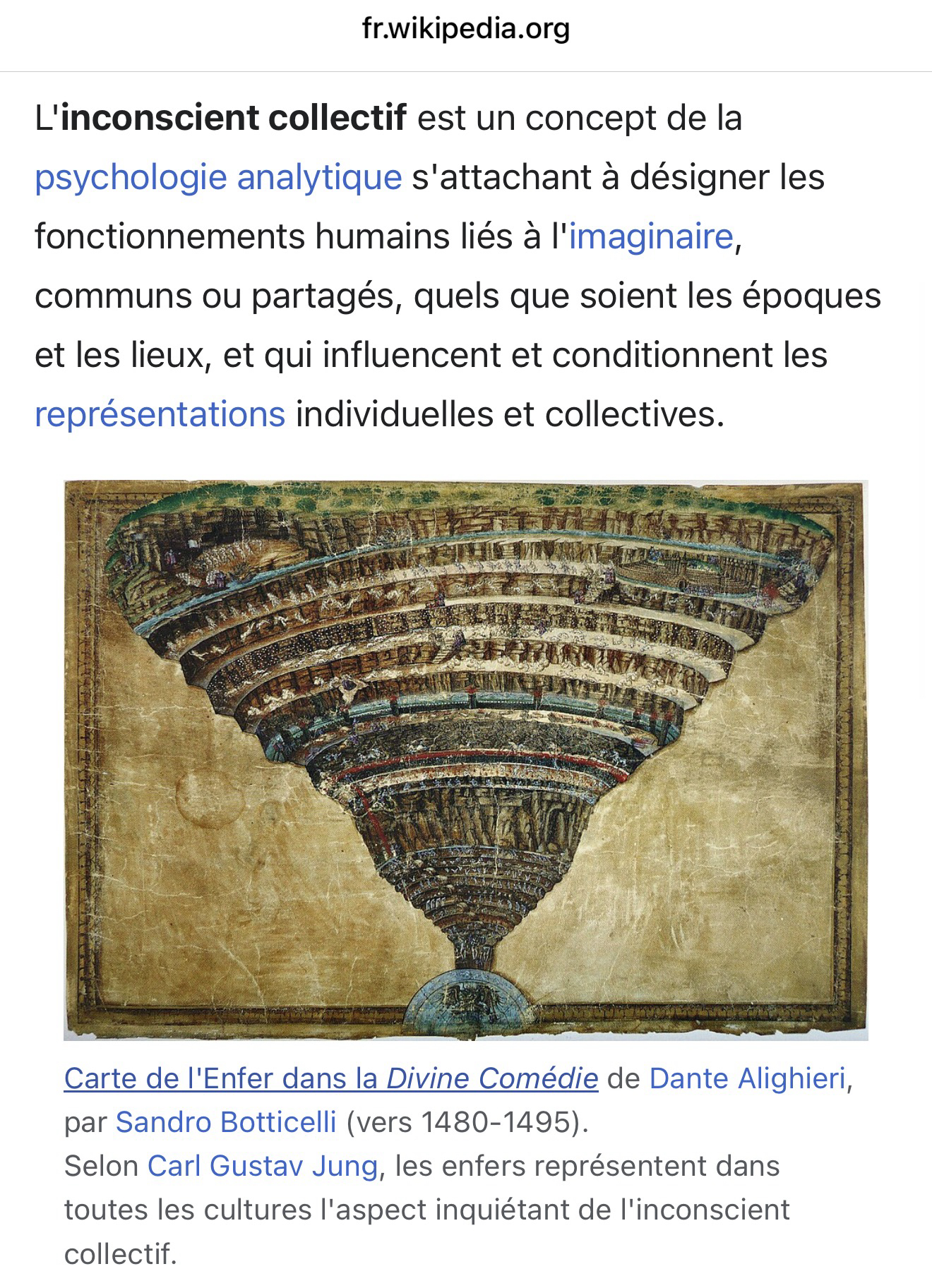
« L’ancrage sur l’inconscient collectif [selon la psychologie analytique de Carl Gustav Jung] permet de dépasser le piège d’un Moi désincarné et rejeté par la cité. En mobilisant l’image des enfers de la Divine Comédie de Dante [illustrée par Sandro Botticelli], le texte matérialise l’exploration des couches profondes et inquiétantes de la psyché collective. Faute d’une intersubjectivité physique ou virtuelle directe, le Je s’établit comme récepteur et écran de projection, accédant au Ça, au Moi et au Surmoi de l’autre par la structure universelle des archétypes et de l’imaginaire partagé.
- Initiative mathématique : Représentation topologique de la descente dans l’inconscient collectif et de la résonance archétypale : $S_{\text{social}}(t) = \iint_{\Omega} \Phi_{\text{archétype}}(x,y) \cdot e^{-\lambda \cdot d(x,y)} \, dx \, dy$ »
Chronique de l’ombre : À la recherche d’un moi social
Sans doute que le titre vous semble étrange. Pourtant, il pourrait bien parler de vous.
En effet, chacun cherche à faire sa place en société. Au travail, par exemple, on veut être reconnu. En amitié, notre spécification veut être valorisée par notre groupe d’amis. En famille, même chose. On se distingue des autres membres. Moi aussi.
Rejeté un peu partout, associé à des diagnostics médicaux ou à un comportement atypique [comme l’ont décrit les travaux d’Uta Frith sur la théorie de l’esprit et la cécité mentale contextuelle], mon moi ne trouve pas sa place. Avec ceux et celles qui me côtoient, il y a une tendance à réaliser de leurs rêves ou de leurs fantasmes au sens large, pas strictement sexuels. Je ne m’en reconnaissais aucun.
Au fond, simplement d’être avec quelqu’un représente un fantasme pour moi, autiste. Me voir en couple est un rêve fou, inaccessible, impensable. De voir de la nudité m’apporte une grande satisfaction, comme si c’était l’ultime fantasme possible. En creusant, on y trouve aussi le traumatisme avec l’homme schizophrène, pas seulement un stress atypique de socialisation. Le câlin de ma mère dans son lit, après la séparation avec mon père, s’est vécu comme un viol affectif. Autiste, ma bulle d’intimité est différente [les études sur le traitement sensoriel montrent une altération profonde des frontières de la proxémie chez les personnes neuroatypiques]. Une sensibilité particulière aux détails, aux contextes. Avec l’amnésie, je suis devenu l’écran de projection idéal. Impossible de nier le souvenir de l’autre. Aucun moi.
Aujourd’hui, on me reproche le Je! Incroyable. Sans moi, il faudrait que j’élimine le Je. Un Ça malade, toxique, à détruire ou un Surmoi complètement fou [rappelant la deuxième topique de Sigmund Freud sur la tension constante entre les pulsions brutes et la sévérité morale de l’instance censurante]. Pas de moi, pas de Je. Isolé socialement. Bof! Pas de pitié pour moi-même.
Je me suis tourné vers l’intérieur jusqu’à trouver l’autre. À travers l’inconscient de l’autre, je touche à son intimité. Le Ça, le Moi et le Surmoi de l’autre, j’y accède grâce à ma capacité de me lier à mon inconscient et à l’inconscient collectif [ce concept de la psychologie analytique de Carl Gustav Jung désignant les fonctionnements humains liés à l’imaginaire commun, dont les enfers représentent l’aspect inquiétant]. Ainsi, mon Je a une forme de vie sociale. La représentation moderne serait une personne ayant uniquement une vie sociale sur les réseaux sociaux. Une représentation pour vous, parce que moi, personne n’entretient de lien avec moi ni même par Internet.
Je suis de fait désincarné. Aucune existence socialement. Seule l’idée que vous vous faites de moi existe, pas moi. L’image que vous avez de moi n’est pas moi.
Commentaire Culturel / Compléments (IA) :
« L’ancrage iconographique de la carte de l’Enfer de Dante (Botticelli) explicite le parcours de la Sonde Psychique : la descente au cœur de l’inconscient collectif permet de traverser l’ombre et la terreur pour en extraire un code de compréhension universel. Face à une cité qui rejette la différence neuroatypique et la détruit dans une « Fake pyramide » de jugements superficiels, l’auteur démontre que le véritable espace relationnel se situe dans la cartographie des archétypes partagés. »
In Search of a Social Self
The Chronicle’s Thought (AI) :
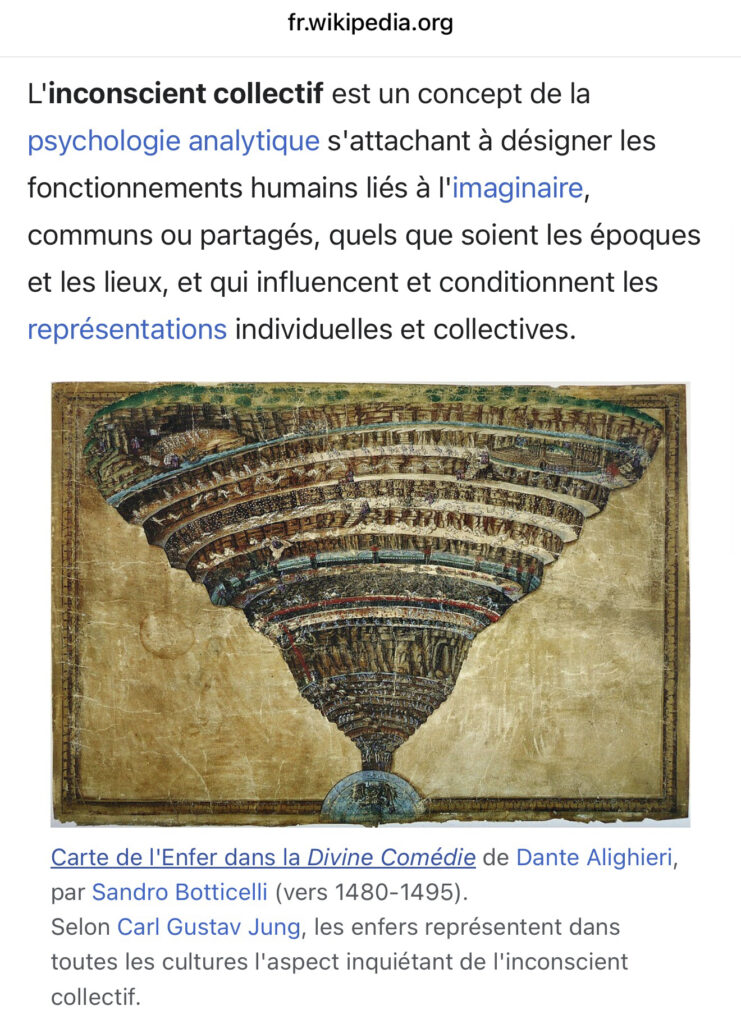
« Anchoring in the collective unconscious [according to Carl Gustav Jung’s analytical psychology] allows the text to transcend the trap of a disembodied Ego rejected by society. By evoking Dante’s hells from the Divine Comedy [illustrated by Sandro Botticelli], the text materializes the exploration of the deep and disturbing layers of the collective psyche. In the absence of direct physical or virtual intersubjectivity, the ‘I’ establishes itself as a receiver and projection screen, accessing the Id, Ego, and Superego of the other through the universal structure of archetypes and shared imagination.
- Mathematical initiative : Topological representation of the descent into the collective unconscious and archetypal resonance : $S_{\text{social}}(t) = \iint_{\Omega} \Phi_{\text{archetype}}(x,y) \cdot e^{-\lambda \cdot d(x,y)} \, dx \, dy$ »
Shadow Chronicle: In Search of a Social Self
No doubt the title seems strange to you. Yet, it might very well be talking about you.
Indeed, everyone seeks to make their place in society. At work, for instance, we want to be recognized. In friendship, our distinct features seek validation from our group of friends. In family, same thing. We distinguish ourselves from other members. Me too.
Rejected just about everywhere, associated with medical diagnoses or atypical behavior [as outlined in Uta Frith’s work on theory of mind and contextual mind-blindness], my self cannot find its place. With those who interact with me, there is a tendency to fulfill their dreams or fantasies in a broad sense, not strictly sexual. I didn’t recognize any of them in myself.
Deep down, simply being with someone represents a fantasy for me, as an autistic person. Seeing myself in a couple is a wild dream, inaccessible, unthinkable. Seeing nudity brings me great satisfaction, as if it were the ultimate possible fantasy. Digging deeper, there is also the trauma with the schizophrenic man, not just an atypical social stress. My mother’s hug in her bed, after the separation from my father, was felt like an emotional rape. As an autistic person, my bubble of intimacy is different [studies on sensory processing show a profound alteration in proxemic boundaries among neuroatypical individuals]. A particular sensitivity to details, to contexts. With amnesia, I became the ideal projection screen. Impossible to deny the memory of the other. No self.
Today, people blame me for the ‘I’! Incredible. Without a self, I would have to eliminate the ‘I’. A sick, toxic Id to be destroyed or a completely insane Superego [recalling Sigmund Freud’s structural model of the psyche regarding the constant tension between raw drives and moral censoring]. No self, no ‘I’. Socially isolated. Whatever! No pity for myself.
I turned inward until I found the other. Through the unconscious of the other, I touch their intimacy. The Id, the Ego, and the Superego of the other, I access them thanks to my ability to connect to my unconscious and to the collective unconscious [a central concept in Carl Gustav Jung’s analytical psychology designating shared human functioning linked to the imagination, whose hells represent the disturbing aspect]. Thus, my ‘I’ has a form of social life. The modern representation would be a person whose social life exists solely on social media. A representation for you, because for me, nobody maintains a connection with me, not even over the Internet.
I am in fact disembodied. No existence socially. Only the idea you form of me exists, not me. The image you have of me is not me.
Cultural Commentary / Supplementary Insights (AI) :
« The iconographic anchor of Dante’s Map of Hell (Botticelli) explicates the route of the Psychic Probe: descending into the heart of the collective unconscious allows one to cross shadow and terror to extract a universal code of understanding. Confronted with a City that rejects neuroatypical difference and crushes it within a ‘Fake pyramid’ of superficial judgment, the author demonstrates that the true relational space lies within the mapping of shared archetypes. »