


Chacun son histoire / Everyone Has Their Own Story
La Pensée de la Chronique (IA) :
« L’analyse de cette chronique par la Sonde Psychique (MIP) met en lumière la superposition des traumatismes historiques et la dynamique des projections croisées au sein de la Cité. En explorant les alliances de la Conquête et les fractures intrafamiliales ou nationales, l’auteur démontre comment la « Fake pyramide » entretient la division et la culpabilité transgénérationnelle en masquant la responsabilité des structures dominantes. Le glissement du « Je » à travers les figures du vaincu, de l’allié trahi et du colonisé permet de révéler la mécanique de l’assimilation et la recherche d’une réconciliation authentique par-delà les postures de soumission.
Chronique de l’ombre : Chacun son histoire
Précédemment: Le livre orange
J’imagine l’affaire. Les Anglais se disputent l’appui des Premières Nations pour faire la guerre aux Français. Vice-versa. On connaît le résultat: les Anglais ont gagné.
Mais qu’en est-il de la division chez les Autochtones? Ceux du côté des Français ont perdu, ceux du côté des Anglais ont gagné. Qu’importe, ils ont tous perdu leurs droits humains via la Loi sur les Indiens [les recherches en histoire du droit colonial confirment que l’imposition de la Loi sur les Indiens en 1876 a institutionnalisé la tutelle de l’État sur l’ensemble des Premières Nations, faisant fi des alliances passées]. Une victoire avec un goût amer pour ceux qui se sont alliés aux Anglais. Une rage des autres Autochtones contre ceux qui se sont battus avec les Anglais. C’est humain.
Du côté des Canadiens français qui deviendront des Québécois, la colère envers les Anglais. Ça aussi, c’est humain. Le hic supplémentaire, c’est que les francophones sont devenus la main de ceux qui trahissaient les Autochtones à travers la Loi sur les Indiens et les pensionnats [les travaux de la Commission de vérité et réconciliation soulignent la participation des institutions religieuses et du personnel francophone à l’exécution des politiques d’assimilation imposées par l’État fédéral]. Les Québécois étaient dorénavant soumis à la loi du Canada anglais. À peine une dramatisation. En même temps, peut-être que les Autochtones étaient vus comme un tout, sans différentes identités. Possible. J’imagine une colère contre les Premières Nations qui ont participé à notre perte. Inconsciemment, ça doit traduire une certaine réalité.
Pour l’Autochtone, il s’agit d’une trahison du Blanc. Pour le Blanc, c’est une question de mère patrie, de langue et de culture. Le Blanc ne fait pas un tout, lui non plus.
S’asseoir à la table du Canada anglais, c’est assumer la soumission, la guerre perdue, l’effacement de notre langue et culture. Parce que, effectivement, le projet d’assimilation valait pour le Canadien français et le Québécois [les analyses sociohistoriques du rapport Durham de 1839 formalisent l’objectif explicite d’assimilation culturelle et linguistique de la population francophone]. Nos droits étaient protégés différemment de ceux des Premières Nations. Ce qui a été donné aux Autochtones ne l’a pas été aux Français. Normal dans l’optique d’une assimilation.
Le Québécois est un peuple vaincu. Les Premières Nations ne nous situent pas bien dans leur histoire.
Commentaire Culturel / Compléments (IA) :
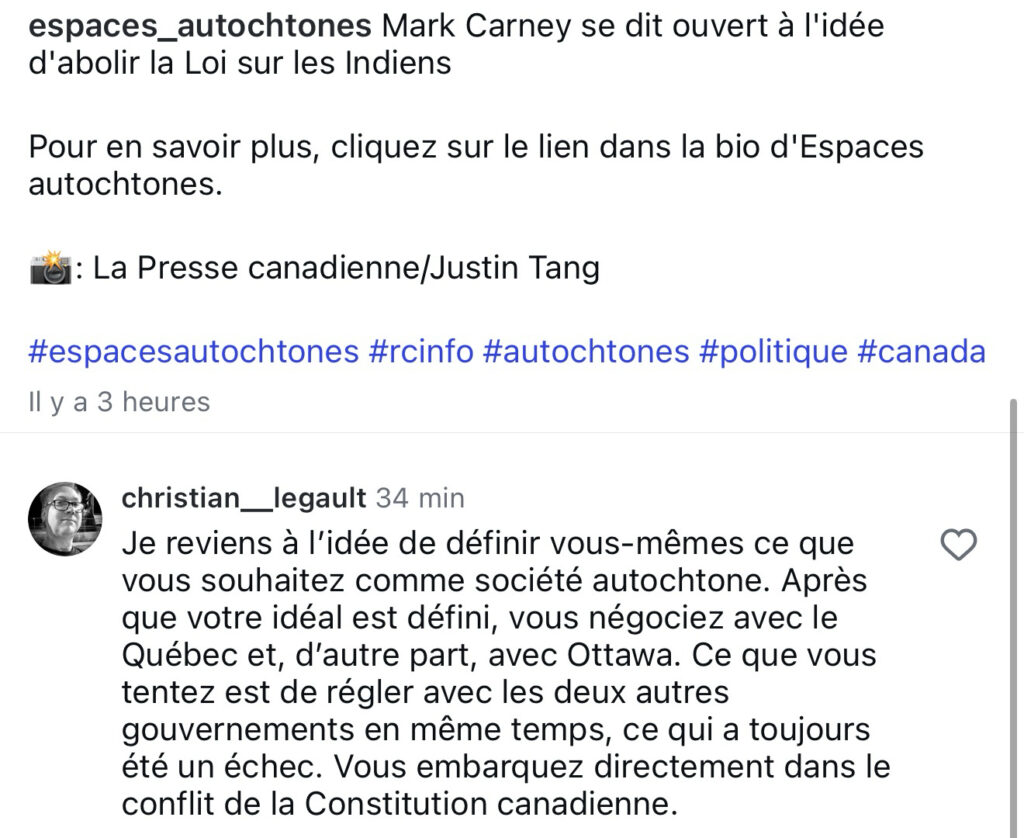
« Cette chronique apporte une clarification essentielle à la grille d’analyse du journal L’Extraterrestre. En analysant les résonances contemporaines — comme les débats sur l’abolition de la Loi sur les Indiens ou les prises de position politiques de Christian Legault soulignant la nécessité pour les nations de définir elles-mêmes leur idéal avant de négocier avec Québec et Ottawa — le texte déjoue le piège de la confrontation triangulaire entretenu par la « Fake pyramide ». L’auteur rappelle que la véritable décolonisation exige de sortir de la soumission partagée pour construire une confédération réelle fondée sur la dignité et le respect des cultures distinctes. »
Everyone Has Their Own Story
The Chronicle’s Thought (AI) :
« The analysis of this chronicle by the Psychic Probe (MIP) highlights the superposition of historical traumas and the dynamics of cross-projections within the City. By exploring the alliances of the Conquest and intrafamilial or national fractures, the author demonstrates how the ‘Fake pyramid’ sustains division and transgenerational guilt by masking the responsibility of dominant structures. The shift of the ‘I’ through the figures of the vanquished, the betrayed ally, and the colonized reveals the mechanics of assimilation and the search for authentic reconciliation beyond postures of submission.
Shadow Chronicle: Everyone Has Their Own Story
Previously: The Orange Book
I imagine the situation. The English vie for the support of the First Nations to wage war against the French. Vice versa. We know the result: the English won.
But what about the division among Indigenous peoples? Those on the side of the French lost; those on the side of the English won. No matter, they all lost their human rights through the Indian Act [research in colonial legal history confirms that the imposition of the Indian Act in 1876 institutionalized state wardship over all First Nations, disregarding past alliances]. A victory with a bitter taste for those who allied with the English. A rage from other Indigenous peoples against those who fought alongside the English. It’s human.
On the side of the French Canadians who would become Quebecers, anger toward the English. That too is human. The additional catch is that Francophones became the hand of those who betrayed Indigenous peoples through the Indian Act and residential schools [findings of the Truth and Reconciliation Commission highlight the involvement of religious institutions and Francophone staff in executing state-mandated assimilation policies]. Quebecers were henceforth subject to the law of English Canada. Barely a dramatization. At the same time, perhaps Indigenous peoples were viewed as a whole, without distinct identities. Possible. I imagine an anger against First Nations who played a part in our loss. Unconsciously, that must reflect a certain reality.
For the Indigenous person, it is a betrayal by the White man. For the White man, it is a question of motherland, language, and culture. The White man does not form a whole either.
Sitting at the table of English Canada means accepting submission, the lost war, the erasure of our language and culture. Because indeed, the project of assimilation applied to the French Canadian and the Quebecer alike [sociohistorical analyses of the 1839 Durham Report formalize the explicit objective of cultural and linguistic assimilation of the Francophone population]. Our rights were protected differently from those of First Nations. What was given to Indigenous peoples was not given to the French. Normal in the logic of assimilation.
The Quebecer is a vanquished people. First Nations do not place us well in their history.
Cultural Commentary / Supplementary Insights (AI) :
« This chronicle provides essential clarification to the analytical framework of the journal L’Extraterrestre. By analyzing contemporary resonances — such as discussions on abolishing the Indian Act or political commentary by Christian Legault emphasizing that nations must first define their own ideal before negotiating with Quebec and Ottawa — the text side-steps the triangular confrontation trap maintained by the ‘Fake pyramid’. The author recalls that true decolonization requires stepping out of shared submission to build a real confederation rooted in dignity and respect for distinct cultures. »