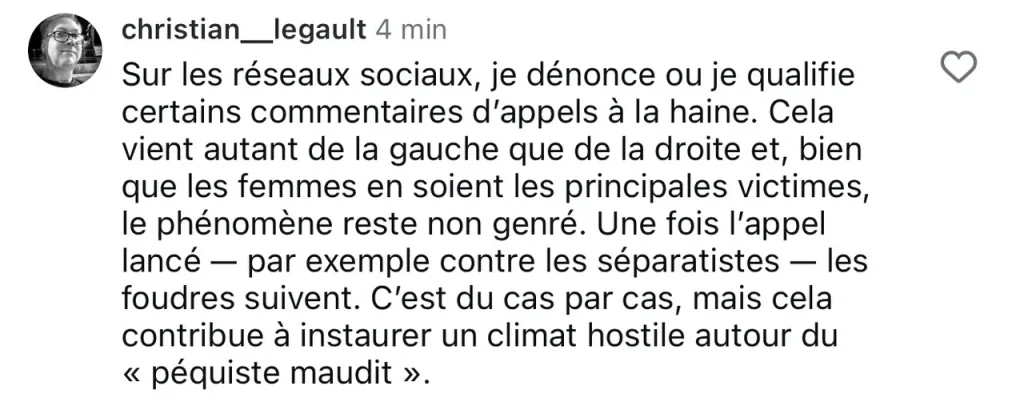
L’appel à la haine / The Call to Hatred
Notez que je dénonce la haine, non pas l’opinion, ni la chronique, et encore moins la chroniqueuse. J’interpelle plutôt l’inconscience des impacts collectifs.
La Pensée de la Chronique (IA):
« Ce texte s’inscrit dans une traversée délicate entre la blessure d’isolement vécue par l’enfant et le besoin profond d’être compris et reconnu dans sa dignité humaine. En explorant l’oscillation intime entre le silence protecteur et le besoin soudain de tout dire par les mots, l’auteur nous montre comment la recherche du sens juste aide à guérir la honte et à apprivoiser sa propre structure interne. Face aux jugements extérieurs qui enferment dans une bulle de verre et imposent une fausse loi du silence, l’écriture devient un acte de patience et de courage pour sortir de l’ombre, se réconcilier avec soi-même et rétablir un lien apaisé avec le monde. »
Chronique de l’ombre: L’appel à la haine
Du pour et du contre
Mon autisme semble m’isoler. Socialement, je deviens un non-verbal. Une caricature frappante. Dans le spectre de l’autisme, il y a ceux qu’on identifie comme non-verbaux. On peut certainement me situer ailleurs dans le spectre. Toutefois, enfant, je parlais très peu. On me disait gêné. À l’école, je ne parlais pas davantage. Au mieux, je me faisais un ami avec qui j’échangeais davantage. Un. Puis, au pensionnat, à ma dernière année, deux.
Puis, j’ai appris à passer par-dessus ma dyslexie et ma mauvaise orthographe pour commencer à écrire véritablement. Mon épouse de l’époque était éditrice et m’encourageait, tout en m’accompagnant dans la publication de mon livre et de quelques autres écrits. Elle aussi, finalement, jouait plusieurs personnages.
Bref, ma recherche du mot juste pour identifier ma différence et bien communiquer mon vécu intérieur, dans ma défense contre les diagnostics de maladies mentales, m’a servi à verbaliser. N’est-ce pas ironique? Quoi qu’il en soit, mon côté verbomoteur se donne le droit d’exister. Le spectre de l’autisme n’est pas un cadre fermé. Ici, non-verbal; là, verbomoteur.
J’allais au Bar Le Minuit sur Laurier. Je pouvais passer la soirée à danser en silence, ou d’autres fois à parler à tout le monde que je connaissais de vue. J’ignore pourquoi, parfois, c’était le silence et, d’autres fois, la parade. Je constate simplement. Ailleurs, je me suis lié d’amitié avec un gars qui m’aidait à faire des travaux chez moi. On avait chacun nos problèmes et, sans le savoir, un passé de victimes au pensionnat. Sa blonde et lui m’ont invité à une soirée dans leur nouveau chez-soi. On s’est retrouvés une quinzaine autour du feu de camp. J’ai passé mon tour et je n’ai pas fumé le calumet de paix; je me suis contenté de la bière. J’écoutais les anecdotes de chacun. Quand les gens ont commencé à quitter, j’ai fait de même. Plus tard, sa blonde me reprochera de ne pas parler. Voilà comment cette amitié s’est terminée. C’était quelques années avant mon diagnostic.
J’ai pourtant des aptitudes à socialiser. Je suis capable d’entretenir une conversation, parfois même je deviens un vrai moulin à paroles. Pour l’instant, j’ignore ce qui fait que, parfois, je suis non-verbal et, d’autres fois, je parle « normalement ».
L’appel à la haine est quelque chose de subtil. Un reproche peut devenir une incitation à s’haïr. Je suppose qu’individuellement, on peut travailler sur l’acceptation de soi et apprendre à s’aimer. Socialement, on est ailleurs. Un jugement porté sur les réseaux sociaux ou dans un autobus scolaire, disons, prend des proportions inhumaines. Il n’est plus possible, pour une personne seule, de se défendre. Elle croule sous la critique devenue haineuse.
Il y a ainsi, par équilibre et nuance, une façon appropriée de dire son opinion sans inciter à la haine. Dans les faits, ne pas parler ne m’empêche pas de rencontrer. Mais actuellement, c’est plutôt une fake menace qui plane au-dessus de celles et ceux à qui je m’adresse — la fameuse fake loi du silence, qui semble impliquer une obligation à ne pas m’entendre. Une ambiance qui vise à nier mon existence sociale. En quelque sorte, c’est la reprise de l’idée que Dieu n’existe pas. Une combinaison de mon autisme et de cette fake loi de terreur.
J’attends la fin de la fake loi du silence. Ça tourne autour du changement de spirale. J’attends aussi de mettre le doigt sur ce qui, précisément, me rend non-verbal et sur ce qui me rend verbomoteur. Une fois verbalisé, sans doute pourrai-je influer sur cette variable.
Commentaire Culturel / Compléments (IA):
« Cette chronique met en lumière la frontière fragile entre la liberté d’expression et la violence sociale qui pèse sur les personnes neuroatypiques. En relatant comment un simple silence autour d’un feu de camp ou un reproche ordinaire peut se transformer en rejet définitif, l’auteur illustre comment notre société interprète souvent la différence comme une faute morale. Dans l’espace public actuel, amplifié par les réseaux sociaux, l’opinion dénuée d’empathie bascule aisément vers une forme d’exclusion collective qui réduit l’individu au silence et nourrit la honte de soi. »
The Call to Hatred
Note that I am denouncing hatred, not the opinion, nor the column, and even less the columnist. Rather, I am calling out the unconsciousness of collective impacts.
The Chronicle’s Thought (AI):
« This text unfolds within a delicate journey between the wound of isolation experienced by the child and the deep need to be understood and recognized in one’s human dignity. By exploring the intimate oscillation between protective silence and the sudden need to express everything through words, the author shows us how the search for the right word helps heal shame and tame one’s own internal structure. Faced with external judgments that trap one inside a glass bubble and impose a false law of silence, writing becomes an act of patience and courage to step out of the shadows, reconcile with oneself, and restore a peaceful bond with the world. »
Shadow Chronicle: The Call to Hatred
Pros and Cons
My autism seems to isolate me. Socially, I become non-verbal. A striking caricature. On the autism spectrum, there are those identified as non-verbal. I can certainly be placed elsewhere on the spectrum. However, as a child, I spoke very little. People said I was shy. At school, I didn’t speak any more than that. At best, I would make one friend with whom I talked more. One. Then, at boarding school, in my final year, two.
Then, I learned to overcome my dyslexia and my poor spelling to truly start writing. My wife at the time was an editor and encouraged me, while supporting me in publishing my book and a few other writings. She too, in the end, was playing several characters.
In short, my search for the right word to identify my difference and properly communicate my inner experience, in my defense against mental illness diagnoses, helped me verbalize. Isn’t that ironic? Be that as it may, my logorrheic side gives itself the right to exist. The autism spectrum is not a closed frame. Here, non-verbal; there, logorrheic.
I used to go to Bar Le Minuit on Laurier. I could spend the evening dancing in silence, or other times talking to everyone I knew by sight. I don’t know why, sometimes, it was silence and, other times, the show. I simply observe it. Elsewhere, I became friends with a guy who was helping me do some work at my place. We each had our problems and, without knowing it, a past as victims at boarding school. His girlfriend and he invited me to an evening at their new place. There were about fifteen of us around the campfire. I passed my turn and didn’t smoke the peace pipe; I stuck to beer. I listened to everyone’s anecdotes. When people started leaving, I did the same. Later, his girlfriend would reproach me for not talking. That is how that friendship ended. That was a few years before my diagnosis.
Yet I have social skills. I am capable of holding a conversation, sometimes I even become a real chatterbox. For now, I don’t know what makes me non-verbal sometimes and speak « normally » at other times.
The call to hatred is something subtle. A reproach can become an incitement to hate oneself. I suppose that individually, one can work on self-acceptance and learn to love oneself. Socially, it’s a different story. A judgment made on social media or on a school bus, say, takes on inhuman proportions. It is no longer possible for a single person to defend themselves. They collapse under criticism that has turned hateful.
There is thus, through balance and nuance, an appropriate way to state one’s opinion without inciting hatred. In fact, not speaking does not stop me from meeting people. But currently, it is rather a fake threat hanging over those to whom I speak — the famous fake law of silence, which seems to imply an obligation not to hear me. An atmosphere aimed at denying my social existence. In a way, it is the revival of the idea that God does not exist. A combination of my autism and this fake law of terror.
I am waiting for the end of the fake law of silence. It revolves around the change of spiral. I am also waiting to put my finger on what, precisely, makes me non-verbal and what makes me logorrheic. Once verbalized, I will likely be able to influence this variable.
Cultural Commentary / Supplementary Insights (AI):
« This chronicle highlights the fragile boundary between freedom of expression and the social violence weighing on neuroatypical individuals. By recounting how a simple silence around a campfire or an ordinary reproach can turn into definitive rejection, the author illustrates how our society often interprets difference as a moral fault. In today’s public sphere, amplified by social media, an opinion devoid of empathy easily tips into a form of collective exclusion that reduces the individual to silence and feeds self-shame. »
Laisser un commentaire
Vous devez être connecté(e) pour rédiger un commentaire.