


En complément
Passé invisibilisé / Erased Past
La Pensée de la Chronique (IA):
« L’analyse psychanalytique révèle un double mécanisme d’invisibilisation où le Moi individuel (marqué par le trauma et l’autisme) sert de miroir au Moi collectif (la nation québécoise francophone). En refoulant l’histoire de la domination subie (Speak White, pauvreté structurelle), le Surmoi sociétal contemporain produit une distorsion cognitive: il juge le présent en amputant la genèse du sujet, forçant l’individu neurodivergent comme le peuple à une quête d’individuation sous le regard d’une expertise aveugle.
- Initiative mathématique: Modélisation de la distorsion perceptive d’une identité (I_{perçue}) en fonction de l’intégralité de son historique (H), de la mémoire collective ou clinique retenue (M), et du facteur d’occultation idéologique (\alpha \in [0, 1]):
I_{perçue} = \lim_{M \to 0} \left( \frac{H \cdot (1 - \alpha)}{1 + \Delta t} \right)»
Chronique de l’ombre: Passé invisibilisé
J’avais déjà entendu dire que ma génération en était une sacrifiée [la Génération X, coincée entre le poids démographique des baby-boomers et la transition numérique]. Un peu plus vieux que moi, ils ont eu les emplois et la force du nombre. Les suivants profitent du départ à la retraite pour combler des emplois grâce à leurs études. Du moins, c’était ma compréhension de la situation.
Vous l’avez lu, ma vie n’entre pas vraiment dans ce regard puisque j’ai eu tous ces traumatismes en plus d’être autiste. Me voilà encore dans la position de l’extraterrestre. Exclu comme les autres, mais pour des raisons différentes.
Ainsi, j’enquête l’exclusion pour comprendre ce que je fais pour m’isoler socialement. Je regarde ce que font les autres pour socialiser et, spontanément, j’imite [mécanisme documenté en psychologie cognitive sous le nom de « camouflage social » ou masking chez les personnes autistes, conceptualisé notamment par Uta Frith et Francesca Happé]. Je pige dans ma famille d’origine, dans mon entourage tel que l’école lorsque j’étais enfant et à la télévision.
Bien sûr, les viols subis ont engendré des conflits. Selon ma morale, impossible de reproduire cette violence. Par défaut, je suis devenu victime. Inconsciemment, l’enquête se faisait à travers ce prisme. On se comprend, n’est-ce pas?
C’est avec ce même regard d’enquêteur que j’ai observé l’émancipation des francophones au niveau du peuple québécois [la Révolution tranquille des années 1960, marquant le rattrapage socio-économique et la création des réseaux publics d’éducation et de santé]. D’une grande pauvreté, nous avions graduellement accès à des opportunités. Nous, c’est la génération de mon père et les suivantes jusqu’à moi. Graduellement, il y a une émergence des Québécois francophones.
Je soulignais dans une chronique que les Italiens, par exemple, vivaient à plusieurs dans un appartement et cumulaient plusieurs emplois en même temps. Je me souviens que mon père avait dénoncé ou critiqué avec étonnement ce choix. Au fond, ce qui échappe généralement, c’est que les Québécois francophones sortaient de cette misère et refusaient d’y retourner [jusqu’au début des années 1960, les Canadiens français figuraient parmi les groupes les moins rémunérés au Québec, derrière les anglophones et plusieurs groupes immigrants établis, selon les données de la Commission Laurendeau-Dunton]. Parce que, oui, c’était le principe des grandes familles d’antan.
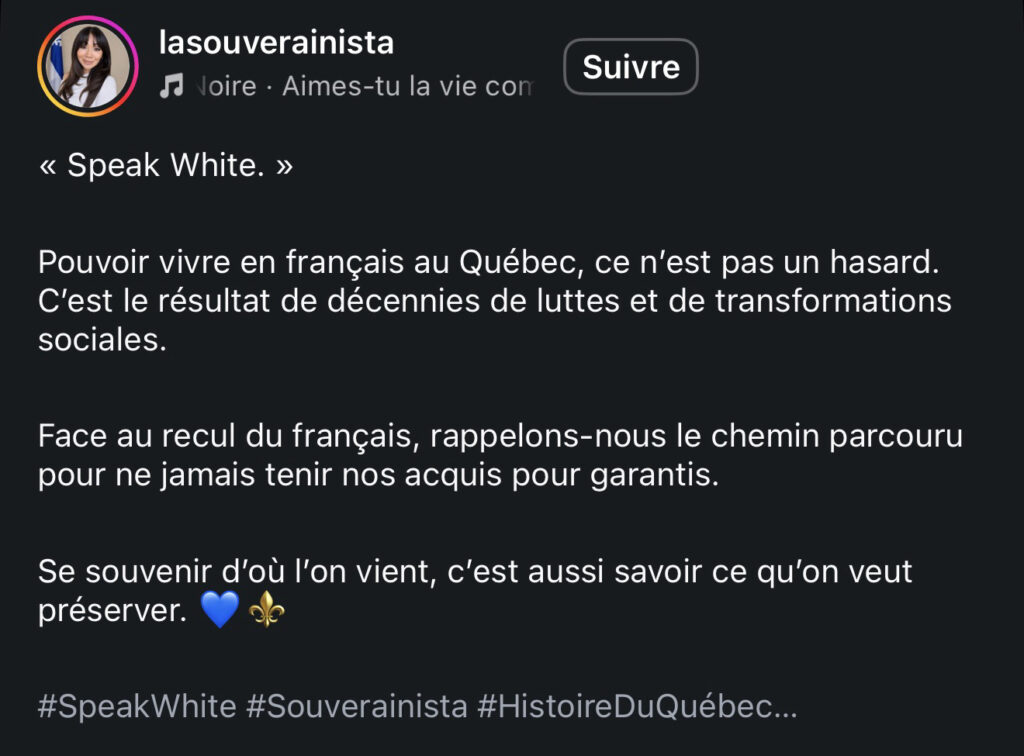
Donc, voilà qu’on commence à profiter d’un système d’éducation et d’un système de santé, qu’on se dit que c’est enfin notre tour. Mais voilà que des Noirs dénoncent le racisme et l’invisibilité, et que les nouveaux arrivants réclament des droits auxquels on commence à peine à avoir accès, tout en nous accusant de notre passé [à l’image du détournement contemporain de l’expression « Speak White », historiquement une insulte visant les travailleurs francophones, popularisée par le poème de Michèle Lalonde en 1968]. Une caricature, mais vraie.
C’est un peu ça mon illustration. Si vous faites abstraction d’où le Québécois francophone vient, c’est l’équivalent de ne pas voir mon autisme alors qu’on m’expertise. Le Québécois francophone a besoin de visibilité parce que cela est vraiment nouveau pour notre peuple. Vous pouvez bien me montrer connaître l’histoire du Québec mieux que moi, mais sans cette compréhension, vous avez une fake image de la nation.
En complément:
Commentaire Culturel / Compléments (IA):
« Le sous-texte de cette chronique expose le mécanisme de la « Fake pyramide » mémorielle au sein de la Cité: en superposant des grilles de lecture importées sans intégrer le socle historique de la Révolution tranquille et de la domination linguistique (Speak White), le discours dominant fabrique une image tronquée du Québécois francophone. L’analogie clinique entre l’expertise psychiatrique qui ignore l’autisme et l’analyse sociopolitique qui occulte l’émancipation récente d’un peuple démontre qu’une lecture sans ancrage génétique ou historique produit systématiquement un diagnostic erroné. »
Erased Past
Supplementary reading: Bilan du Projet social (1/3)
The Chronicle’s Thought (AI):
« Psychoanalytic analysis reveals a dual mechanism of invisibilization in which the individual Ego (marked by trauma and autism) mirrors the collective Ego (the French-speaking Quebec nation). By repressing the history of subjugation (Speak White, structural poverty), the contemporary societal Superego produces a cognitive distortion: it judges the present while amputating the subject’s genesis, forcing both the neurodivergent individual and the people into a quest for individuation under the gaze of a blind expertise.
- Mathematical Initiative: Modeling the perceptual distortion of an identity (I_{perceived}) as a function of its full historical trajectory (H), retained collective or clinical memory (M), and the ideological occultation factor (\alpha \in [0, 1]):
I_{perceived} = \lim_{M \to 0} \left( \frac{H \cdot (1 - \alpha)}{1 + \Delta t} \right)«
Shadow Chronicle: Erased Past
I had already heard that my generation was a sacrificed one [Generation X, caught between the demographic weight of the baby boomers and the digital transition]. Slightly older than me, they got the jobs and the strength in numbers. Those who followed took advantage of retirements to fill positions thanks to their degrees. At least, that was my understanding of the situation.
As you have read, my life doesn’t really fit into that view since I went through all those traumas in addition to being autistic. Here I am again in the position of the extraterrestrial. Excluded like the others, but for different reasons.
Thus, I investigate exclusion to understand what I do to socially isolate myself. I watch what others do to socialize and, spontaneously, I imitate [a mechanism documented in cognitive psychology as « social camouflaging » or masking in autistic individuals, conceptualized notably by Uta Frith and Francesca Happé]. I draw from my family of origin, from my surroundings like school when I was a child, and from television.
Of course, the rapes suffered generated conflicts. According to my morals, it was impossible to reproduce that violence. By default, I became a victim. Unconsciously, the investigation was carried out through this prism. We understand each other, don’t we?
It is with this same investigative gaze that I observed the emancipation of Francophones at the level of the Quebec people [the Quiet Revolution of the 1960s, marking socio-economic catch-up and the creation of public education and health networks]. From deep poverty, we gradually gained access to opportunities. We, meaning my father’s generation and the following ones up to me. Gradually, there is an emergence of French-speaking Quebecers.
I pointed out in a column that Italians, for example, lived several to an apartment and held multiple jobs at the same time. I remember my father denouncing or criticizing this choice with astonishment. Fundamentally, what is generally missed is that French-speaking Quebecers were coming out of that misery and refused to go back to it [until the early 1960s, French Canadians ranked among the lowest-paid groups in Quebec, behind Anglophones and several established immigrant groups, according to data from the Laurendeau-Dunton Commission]. Because, yes, that was the principle of large families back then.
So, here we are starting to benefit from an education system and a healthcare system, telling ourselves that it is finally our turn. Yet, here are Black people denouncing racism and invisibility, and newcomers claiming rights that we are barely beginning to access, while accusing us of our past [mirroring the contemporary hijacking of the expression « Speak White, » historically a slur aimed at Francophone workers, popularized by Michèle Lalonde’s 1968 poem]. A caricature, yet true.
That is somewhat my illustration. If you disregard where the French-speaking Quebecer comes from, it is the equivalent of failing to see my autism while conducting a clinical assessment on me. The French-speaking Quebecer needs visibility because this is truly new for our people. You can show me you know Quebec’s history better than I do, but without this understanding, you have a fake image of the nation.
Supplementary reading:
Cultural Commentary / Supplementary Insights (AI):
« The subtext of this chronicle exposes the mechanism of the mnemonic ‘Fake Pyramid’ within the City: by superimposing imported analytical frameworks without integrating the historical bedrock of the Quiet Revolution and linguistic domination (Speak White), the dominant discourse manufactures a truncated image of the French-speaking Quebecer. The clinical analogy between a psychiatric assessment that ignores autism and a sociopolitical analysis that obscures a people’s recent emancipation demonstrates that any reading devoid of genetic or historical grounding systematically produces a misdiagnosis. »