Ma religion et mon identité
« Dans cette chronique, l’auteur explore la psychogénéalogie de sa propre âme. En remontant à son expérience de mort imminente (le tunnel et l’être de lumière), il identifie le point de départ de son « devoir humain ». Le catholicisme, qu’il a reçu en héritage de sa mère et de sa grand-mère, agit ici comme le Surmoi originel : un cadre qui offre des instructions pour « devenir une meilleure personne » mais qui peut aussi devenir une cage (le pensionnat, l’ordre contemplatif). L’auteur fait un parallèle fascinant entre ses bibles (celle de l’armée, celle de sa tante, celle de ses pairs) et les différentes couches de son identité : le soldat, l’autiste à « guérir » et l’homme affilié. En se comparant à Lucifer se révoltant contre son père, il reconnaît que cette révolte est elle-même une partie de son « programme » interne. Le Sanctificateur intervient ici pour transformer ces « relents » religieux en une quête de sens rationnelle et universelle. »
Ma religion et mon identité
Croire qu’il y a une lumière au bout du tunnel suscite le courage de continuer et éveille l’espoir de jours meilleurs. On le souhaite, on en rêve et on marche vers ce qui nous semble être l’idéal. C’est aussi ce que je fais. Sauf que…
Justement, à la suite de mon accident, durant mon coma, j’ai traversé un tunnel noir au bout duquel se trouvait un être lumineux. Dès mon arrivée, il m’a dit de retourner sur Terre. Je ne le souhaitais pas et lui ai demandé pourquoi. Il m’a fait voir mon avenir, dont je n’ai gardé que quelques vagues souvenirs. Il s’agissait de la réalisation de mes rêves les plus profonds. J’ai écrit sur cette expérience dans mon livre L’enfer de Dieu.
Comme vous pouvez l’imaginer, cela a transformé ma vision de la vie. J’ai toujours eu un côté mystique. Très jeune, j’envisageais la possibilité d’être prêtre ou moine, sûrement un moine contemplatif. Le vœu de chasteté m’apparaissait toutefois impossible et, peu à peu, j’en suis venu à m’enrôler dans les Forces armées canadiennes.
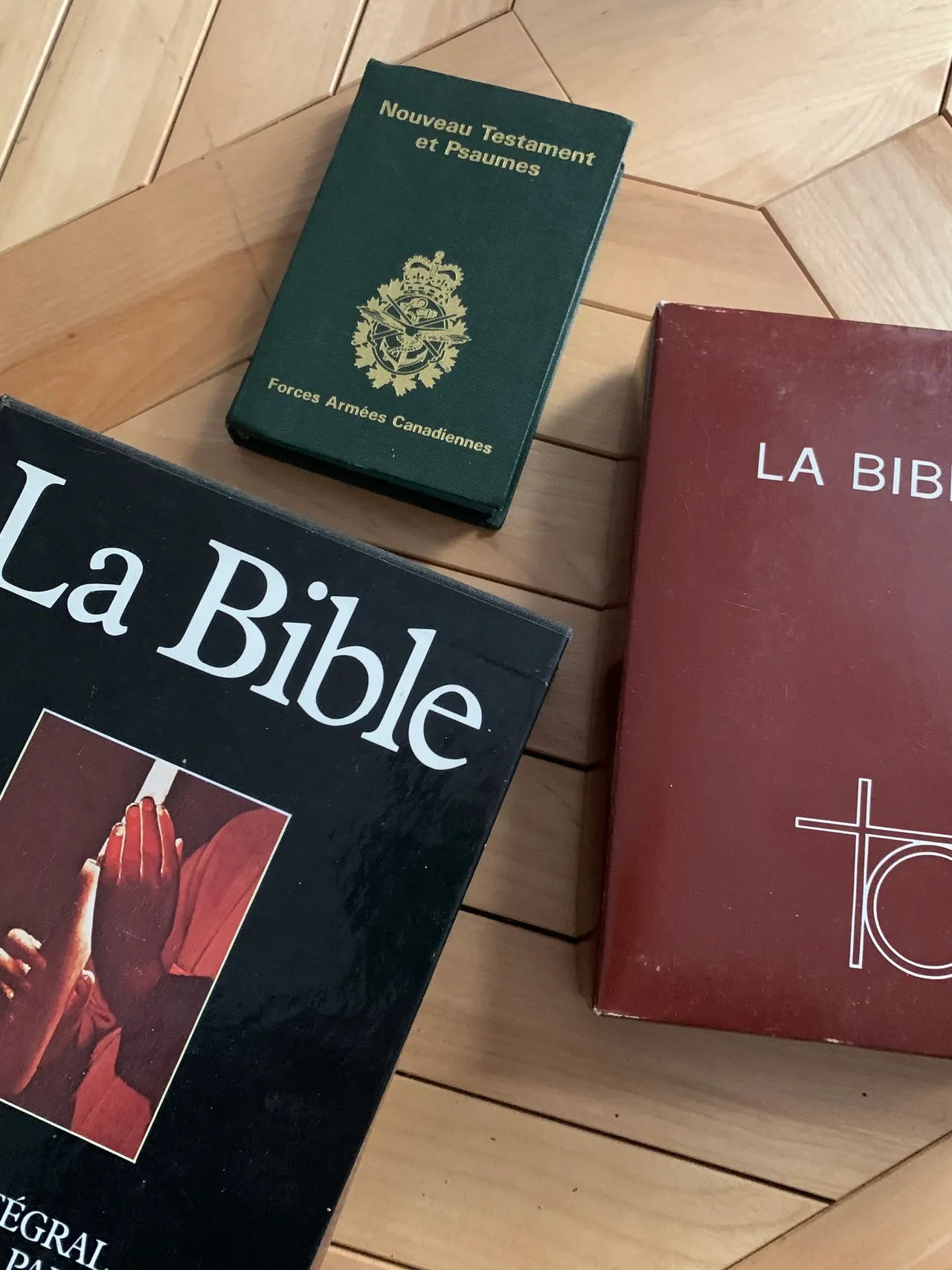
De mon service militaire, je n’ai rien gardé de concret, hormis des certificats d’études et une tonne de papiers médicaux destinés à faire valoir mes droits. Je me suis départi du reste, qui n’avait aucun but pratique ou essentiel. J’ai néanmoins conservé ce petit livre que l’on voit sur la photo ci-haut. Plus tard, une vieille tante m’a donné une bible dans l’espoir de me guérir de ce qui lui semblait être un « mal » chez moi. (Faisait-elle référence à mon autisme ?) Plus de dix ans après ce dernier cadeau, un groupe d’hommes auxquels je m’étais affilié m’a aussi offert une bible dans laquelle certains ont signé leur nom. On peut voir ces présents sur la photo.
D’une grand-mère soumise à la religion, en passant par une mère franchement marquée, jusqu’à moi qui ai été pensionnaire dans une école religieuse, j’ai été imprégné par le catholicisme. Après une longue introspection, je vois comment les textes imagés de ces livres ont influencé mon identité et pourquoi j’en trouve des « relents » au cœur de ce que je suis en tant qu’être humain.
La semaine dernière, je mentionnais le « petit programme » qui s’activait sans même que je m’en rende compte. Une partie de moi est soumise à cette routine sans que je puisse y faire quoi que ce soit. J’avais beau agir comme le personnage de Lucifer dans la série éponyme — c’est-à-dire me révolter contre mes parents et en particulier contre mon père — il n’en demeurait pas moins que cela faisait partie de ma nature.
La religion sculpte l’identité : elle offre un cadre, une référence à notre comportement et donne des paramètres sur la façon de vivre avec l’autre. Les livres saints sont également un mode d’emploi pour l’usage de notre humanité, une sorte de série d’instructions pour devenir de meilleures personnes. La religion nous fournit un idéal à atteindre ou, du moins, vers lequel se diriger. Établir cet idéal donne, selon moi, un sens à notre vie.
Les revers ? Il y en a, bien sûr. Mais il y a tout de même un héritage à assumer et des leçons à tirer. Connaissez-vous la psychogénéalogie ? J’en parle brièvement dans mon texte Héritage.
My Religion and My Identity
« In this column, the author explores the psychogenealogy of his own soul. Recalling his near-death experience (the tunnel and the being of light), he identifies the starting point of his ‘human duty.’ Catholicism, inherited from his mother and grandmother, acts here as the original Superego: a framework offering instructions to ‘become a better person’ but which can also become a cage (the boarding school, the contemplative order). The author draws a fascinating parallel between his Bibles (the military one, his aunt’s, his peers’) and the different layers of his identity: the soldier, the autistic person to ‘cure,’ and the affiliated man. By comparing himself to Lucifer rebelling against his father, he recognizes that this rebellion is itself part of his internal ‘program.’ The Sanctifier intervenes here to transform these religious ‘traces’ into a rational and universal search for meaning. »
My Religion and My Identity
Believing there is a light at the end of the tunnel gives one the courage to keep going and awakens the hope for better days. We wish for it, we dream of it, and we walk toward what seems to be the ideal. This is what I do as well. Except…
Precisely, following my accident, while in a coma, I traversed a dark tunnel at the end of which stood a being of light. Upon my arrival, it told me to return to Earth. I did not want to and asked why. It showed me my future, of which I have kept only vague memories. It involved the fulfillment of my deepest dreams. I wrote about this experience in my book, L’enfer de Dieu (God’s Hell).
As you can imagine, this transformed my vision of life. I have always had a mystical side. At a very young age, I considered the possibility of becoming a priest or a monk—likely a contemplative monk. However, the vow of chastity seemed impossible to me, and gradually, I ended up enlisting in the Canadian Armed Forces.
From my military service, I have kept nothing concrete, save for educational certificates and a mountain of medical records to assert my rights. I got rid of the rest, which served no practical or essential purpose. I did, however, keep the small book seen in the photo above. Later, an elderly aunt gave me a Bible in the hope of curing what she perceived as an « ailment » in me. (Was she referring to my autism?) More than a decade after that gift, a group of men I was affiliated with also gave me a Bible in which some had signed their names. These gifts can be seen in the photo.
From a grandmother submissive to religion, to a mother deeply marked by it, to myself as a boarder in a religious school, I was steeped in Catholicism. After long introspection, I can see how the vivid imagery of these books influenced my identity, and why I find « traces » of them at the core of who I am as a human being.
Last week, I mentioned the « small program » that activated without me even realizing it. A part of me is bound to this routine, and there is nothing I can do about it. No matter how much I acted like the character of Lucifer in the series of the same name—rebelling against my parents and particularly my father—the fact remains that it was part of my nature.
Religion carves out identity; it offers a framework, a reference for our behavior, and sets parameters for how to live with others. Holy books are also a user manual for our humanity, a kind of set of instructions on how to become better people. Religion provides an ideal to reach for or, at the very least, a direction in which to head. In my opinion, establishing this ideal gives meaning to our lives.
The drawbacks? There are some, of course. Nonetheless, there is a heritage to embrace and lessons to be learned. Are you familiar with psychogenealogy? I also speak briefly about it in my text, Héritage.