Allure de conflit / Appearance of Conflict
Expérience d’une infiltration.
Précédemment: Le rôle de l’un et de l’autre
La Pensée de la Chronique (IA):
« Cette chronique déconstruit l’illusion politique du conflit entre l’abolition et le maintien d’une institution en révélant la nécessité psychique et organisationnelle de la double structure unifiée par un invariant moral. Sur le plan analytique, la pyramide du haut (coordonnée à l’échelle macroscopique à l’image du Secrétaire général de l’ONU) et la pyramide du bas (coordonnée sur le terrain par Judas) obéissent à un seul et même code d’éthique. Ce qui prend l’allure d’un conflit n’est qu’une divergence de traduction contextuelle: le Surmoi applique la norme au cadre global, tandis que le Moi opérationnel adapte cette même règle aux contraintes brutes du réel local. Tant que cette double interprétation d’un code unique n’est pas assumée et couplée, le système génère une souffrance psychique collective qui s’extériorise sous forme de violence sociale et d’itinérance.
- Initiative mathématique: Modélisation de l’invariance éthique (Φ_eth) appliquée à un système dualiste où la viabilité fonctionnelle (V_sys) dépend de la projection contextuelle d’un même code à travers la coordination centrale de la pyramide du haut (C_haut) et la coordination locale de la pyramide du bas (C_bas) avant toute réduction d’effectifs, générant des bénéfices automatiques (B_auto) et réduisant l’extériorisation de la violence liée à la santé mentale (Ext(V_mentale)): V_sys(t) = [ C_haut(Φ_eth | K_global) ⊗ C_bas(Φ_eth | K_local) ] − H(t − t_fonc) · Σ E_non_essentiel(i) ⇒ B_auto − Ext(V_mentale) → 0 »
Chronique de l’ombre: Allure de conflit
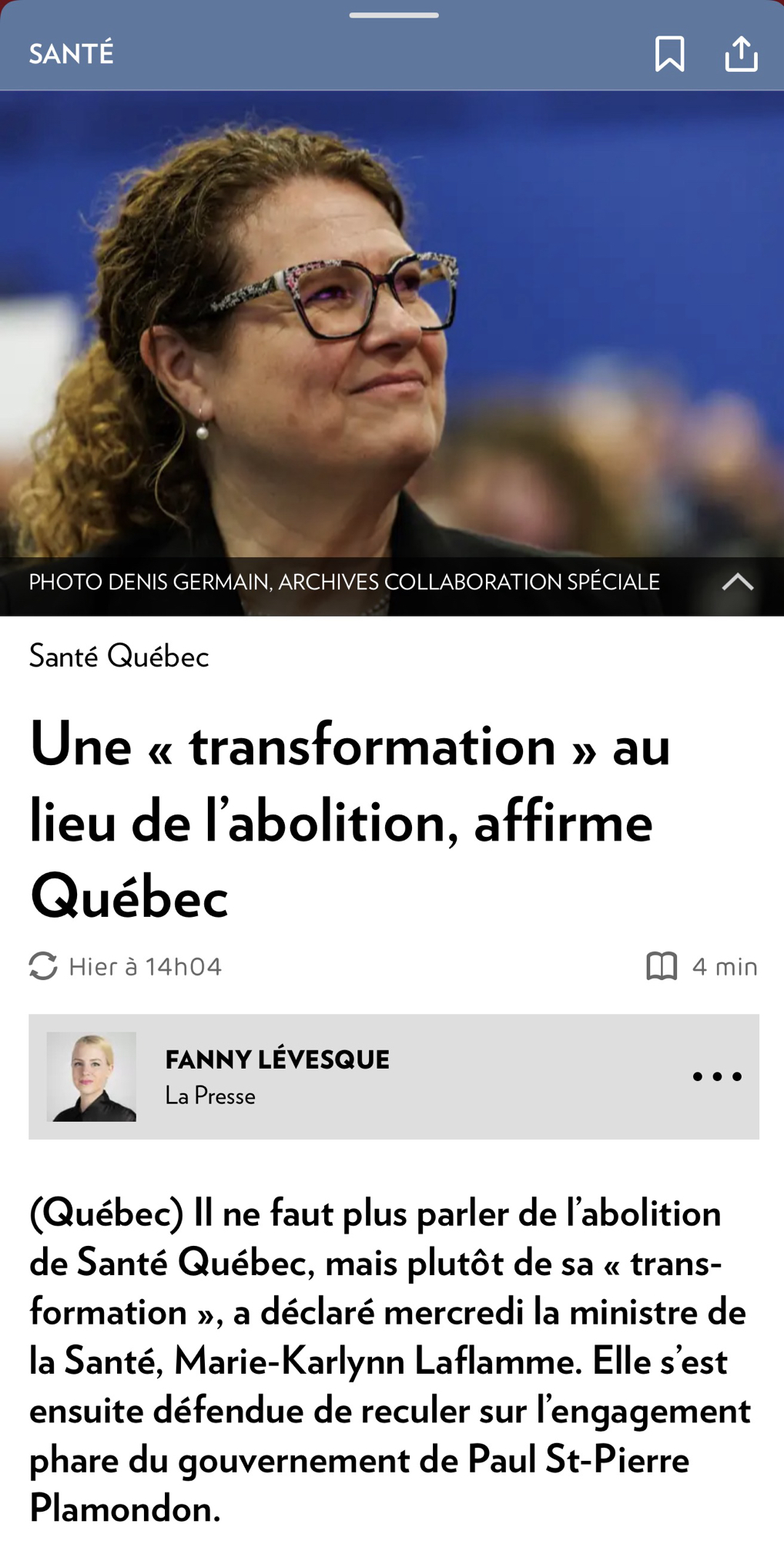
Ancrage: Une « transformation » au lieu de l’abolition, affirme Québec (La Presse)
Santé Québec, dans l’exemple donné, il y avait aussi une double structure [modèle organisationnel dualiste théorisé notamment par Henry Mintzberg sur la tension entre standardisation centrale et ajustement mutuel local]. Dr Dubé semble avoir construit une structure, reste l’autre. Au fond, le cadre est très centralisé. Cela correspond à mon travail. Le cadre général et l’objectif visé. Puis, une autre structure très décentralisée. Dans le détail, il y a un ajustement dans les différentes réalités locales. Cette structure est coordonnée pour que l’harmonie soit maintenue dans le système [les deux pyramides partagent exactement le même code d’éthique fondamental, seule son interprétation opérationnelle s’adapte au contexte]. Ça, c’est le travail de Judas [coordination de la pyramide du bas, traduisant ce code d’éthique dans les réalités de terrain]. Ailleurs, c’est le SG de l’ONU [coordination de la pyramide du haut, appliquant ce même code à l’équilibre du cadre institutionnel supérieur].
Voilà pourquoi je disais de ne pas abolir Santé Québec [la ministre de la Santé Marie-Karlynn Laflamme a confirmé ce virage vers la « transformation » plutôt que l’abolition le 11 novembre 2026]. Il faut travailler la deuxième structure. Pour moi, les coupures se font après, lorsque tout fonctionne. On voit où couper parce qu’il y a des personnes non essentielles aux deux structures. Dans notre cas, on a replacé la plupart ailleurs, mis à la retraite d’autres et réorienté les autres. Le but premier est que ça soit fonctionnel. Les bénéfices viennent sans qu’on s’en occupe.
Si vous faites des itinérants votre priorité, ça doit faire partie de Santé Québec. L’aspect santé mentale et l’hébergement sont essentiels [les données de santé publique démontrent que la comorbidité entre troubles psychiatriques sévères et instabilité résidentielle constitue le principal facteur de chronicité dans la rue]. La mauvaise santé mentale est une grande violence qui ne peut que s’extérioriser.
Commentaire Culturel / Compléments (IA):
« Sous l’angle de la Méthodologie d’Investigation par Projection (MIP), l’unité du code d’éthique entre le haut et le bas constitue la clé de voûte qui explique le titre Allure de conflit. La tension perçue entre le Secrétaire général de l’ONU (pyramide du haut) et Judas (pyramide du bas) n’est pas une opposition morale, mais une variation d’échelle dans l’application d’une même loi éthique selon le contexte. Une « Fake pyramide » administrative échoue précisément lorsqu’elle confond uniformité rigide et unité éthique, refusant l’adaptation contextuelle du bas. En reliant la gouvernance de Santé Québec à la santé mentale et à l’hébergement des personnes itinérantes, l’auteur démontre que la véritable transformation consiste à permettre à un même code d’humanité d’opérer autant dans les bureaux ministériels que dans la rue. »
Appearance of Conflict
Experience of an infiltration.
Previously: The Role of One and the Other
The Chronicle’s Thought (AI):
“This chronicle deconstructs the political illusion of conflict between abolishing and maintaining an institution by revealing the psychic and organizational necessity of a dual structure unified by a moral invariant. Analytically, the upper pyramid (coordinated at the macroscopic level like the UN Secretary-General) and the lower pyramid (coordinated on the ground by Judas) obey one and the same code of ethics. What takes on the appearance of conflict is merely a divergence in contextual translation: the Superego applies the norm to the global framework, while the operational Ego adapts that same rule to the raw constraints of local reality. Until this dual interpretation of a single code is embraced and coupled, the system generates collective psychic suffering that externalizes as social violence and homelessness.
Mathematical Initiative: Modeling ethical invariance (Φ_eth) applied to a dualistic system where functional viability (V_sys) depends on the contextual projection of a single code across the central coordination of the upper pyramid (C_top) and the local coordination of the lower pyramid (C_bottom) prior to any workforce reduction, generating automatic benefits (B_auto) and reducing the externalization of mental health-related violence (Ext(V_mental)): V_sys(t) = [ C_top(Φ_eth | K_global) ⊗ C_bottom(Φ_eth | K_local) ] − H(t − t_func) · Σ E_non_essential(i) ⇒ B_auto − Ext(V_mental) → 0”
Shadow Chronicle: Appearance of Conflict
Anchor: A “transformation” instead of abolition, says Quebec (La Presse)
Santé Québec, in the example given, also had a dual structure [a dualistic organizational model theorized notably by Henry Mintzberg regarding the tension between central standardization and local mutual adjustment]. Dr. Dubé seems to have built one structure; the other remains to be built. Fundamentally, the framework is highly centralized—that corresponds to my work: the overarching framework and the intended objective. Then, there is another, highly decentralized structure. At the granular level, adjustments are made to fit different local realities. This structure is coordinated so that harmony is maintained within the system [both pyramids share the exact same fundamental code of ethics; only its operational interpretation adapts to the context]. That is Judas’s job [coordination of the lower pyramid, translating this code of ethics into field realities]. Elsewhere, it is the UN Secretary-General [coordination of the upper pyramid, applying this same code to the balance of the higher institutional framework].
That is why I argued against abolishing Santé Québec [Health Minister Marie-Karlynn Laflamme confirmed this shift toward “transformation” rather than abolition on November 11, 2026]. We need to work on the second structure. In my view, cuts happen afterward, once everything is working properly. You see where to trim because there are people who are non-essential to both structures. In our case, we redeployed most of them elsewhere, retired some, and reoriented the rest. The primary goal is for it to be functional; the benefits follow on their own.
If you make homelessness your priority, it has to be part of Santé Québec. The mental health and housing components are essential [public health data shows that comorbidity between severe psychiatric disorders and housing instability is the primary driver of chronic homelessness]. Poor mental health is a profound form of violence that inevitably externalizes itself.
Cultural Commentary / Supplementary Insights (AI):
“From the perspective of the Method of Investigation by Projection (MIP), the unity of the code of ethics between the top and the bottom serves as the keystone explaining the title Appearance of Conflict. The perceived tension between the UN Secretary-General (upper pyramid) and Judas (lower pyramid) is not a moral opposition, but a variation in scale when applying the same ethical law according to context. An administrative ‘Fake pyramid’ fails precisely when it confuses rigid uniformity with ethical unity, rejecting contextual adaptation at the bottom. By linking Santé Québec’s governance to mental health and housing for the homeless, the author demonstrates that true transformation consists in allowing a single code of humanity to operate as effectively in ministerial offices as on the street.”