
Chronique de l’ombre: Des repères
Mon commentaire
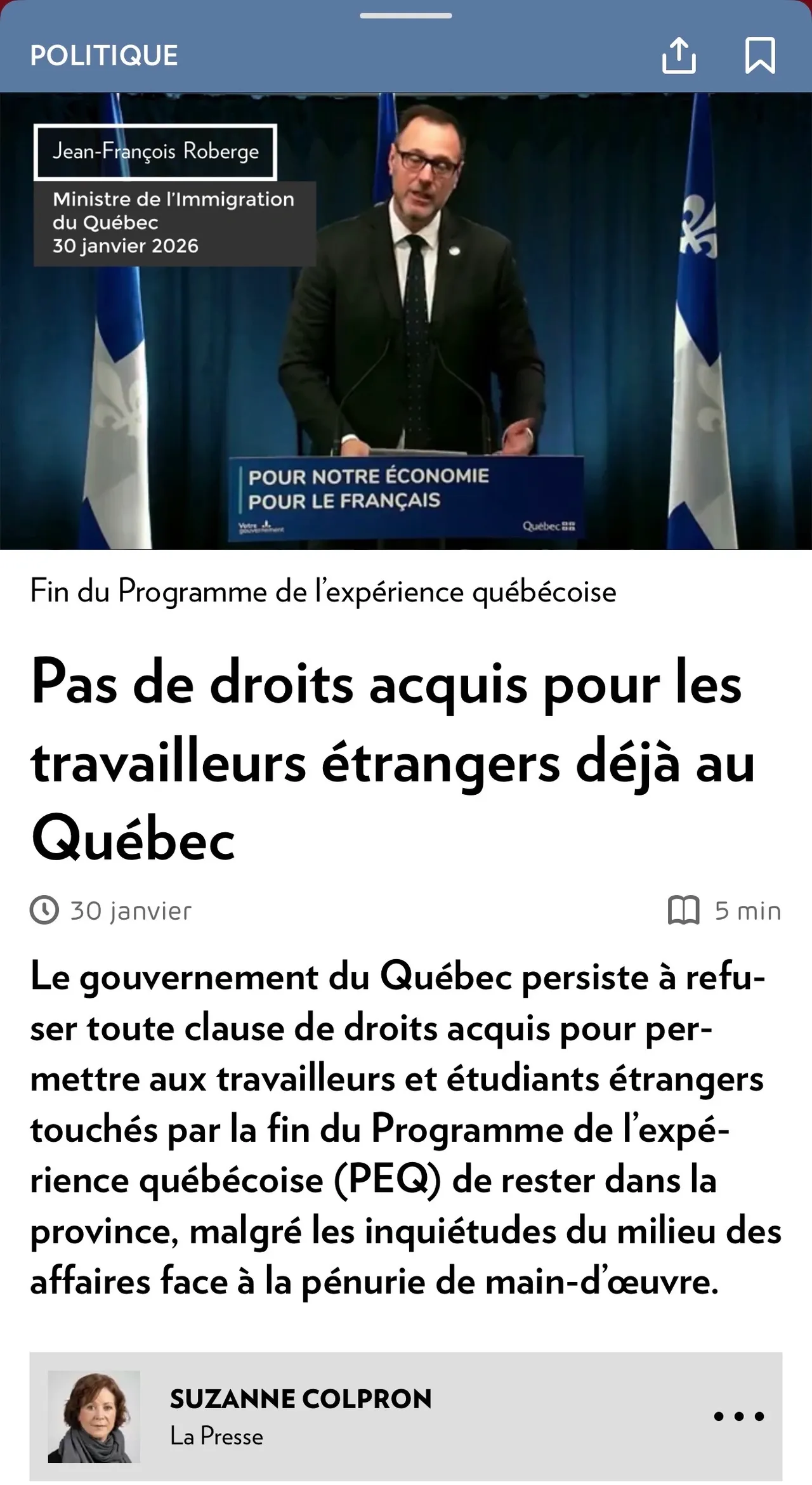
Peut-être comme plusieurs, je ne comprends rien à cette histoire. Dans l’actualité, on voit des personnes maîtrisant suffisamment le français et travaillant dans des secteurs où il y a de grands besoins. C’est certainement un manque de planification. Les objectifs du fédéral diffèrent de ceux du provincial, surtout du Québec francophone.
« Dans cette réflexion sur les « repères » nationaux, l’auteur analyse l’immigration non pas comme une menace humaine, mais comme un enjeu de planification systémique. Il souligne le paradoxe d’un Québec qui, tout en valorisant la liberté, voit son identité s’effriter sous le poids de choix linguistiques et religieux divergents. L’auteur apporte une perspective cruciale en liant la laïcité québécoise à un traumatisme collectif — celui des abus passés de l’Église — expliquant ainsi pourquoi le rejet des signes religieux est, pour beaucoup, une étape nécessaire de guérison et d’émancipation. En remontant aux racines coloniales, il rappelle que les tensions actuelles sont les cicatrices d’un conflit historique dont les Premiers Peuples subissent encore les contrecoups. »
Chronique de l’ombre: Des repères
Précédemment : Déconstruire la fake politique
Je distingue la communauté anglophone historique des immigrants qui choisissent de vivre en anglais. Il s’agit de deux groupes différents. C’est là où se trouve un problème avec l’immigration, selon mon analyse.
Ce n’est pas d’être contre l’immigration, mais de renforcer l’identité culturelle d’un peuple. En s’associant à la langue canadienne commune anglaise, les personnes ayant une autre langue maternelle se retrouvent opposées à la culture québécoise francophone. Une personne, 10 personnes, 100 personnes, ce n’est pas un souci. Le Québec est une nation qui valorise la liberté. Mais lorsqu’une majorité de nouveaux arrivants choisit l’anglais comme langue d’usage, année après année, pendant des décennies, le Québec voit son identité culturelle disparaître ou s’affaiblir. De moins en moins de repères.
Sous l’angle de la religion, le processus se reproduit. Le Québécois francophone est essentiellement catholique dans sa culture implicite, non-pratiquant et pour une laïcité. Laïcité : séparation des pouvoirs religieux et de l’État. Pas contre la religion, pas contre le catholicisme, mais encore choqué par les cas de pédophilie commis par des religieux et, sûrement, d’autres abus en politique. Des immigrants qui remettent en question notre choix de laïcité ignorent ce traumatisme faisant partie de l’identité culturelle de beaucoup. Il est impossible d’ignorer l’impact des agressions sexuelles dans le désir d’émancipation des Québécois. Sans sévices ni abus, cette distanciation avec la religion n’aurait pas eu lieu de la même manière.
Ce n’est donc pas les immigrants qui sont un souci, mais les choix systémiques contraires qui affaiblissent l’identité culturelle québécoise du francophone.
À la base, il faut remonter à la colonisation ; c’était la guerre entre les Britanniques et les Français. Les Premières Nations, Inuits et Métis ont été forcés à choisir leur camp sans avoir l’historique de cette guerre européenne. Ce déchirement perdure encore entre nos trois peuples.
Shadow Chronicles: Landmarks
My Comment
Like many others, perhaps, I find this whole situation confusing. In the news, we see people who have a sufficient command of French and are working in high-demand sectors [being targeted]. This is certainly a lack of planning. Federal objectives differ from provincial ones, especially those of Francophone Quebec.
« In this reflection on national ‘landmarks,’ the author analyzes immigration not as a human threat, but as an issue of systemic planning. He highlights the paradox of a Quebec that, while valuing freedom, sees its identity erode under the weight of diverging linguistic and religious choices. The author provides a crucial perspective by linking Quebec’s secularism to collective trauma—that of past Church abuses—explaining why the rejection of religious symbols is, for many, a necessary step toward healing and emancipation. By tracing back to colonial roots, he reminds us that current tensions are the scars of a historical conflict that First Peoples are still enduring today. »
Shadow Chronicles: Landmarks
Previously: Deconstructing Fake Politics
I distinguish the historical Anglophone community from immigrants who choose to live in English. These are two different groups. According to my analysis, this is where a problem with immigration lies.
It is not about being against immigration, but about strengthening a people’s cultural identity. By aligning themselves with English as the common Canadian language, people with a different mother tongue find themselves in opposition to Francophone Quebec culture. One person, ten people, a hundred people—that is not an issue. Quebec is a nation that values freedom. However, when a majority of newcomers choose English as their primary language year after year, for decades, Quebec sees its cultural identity disappear or weaken. There are fewer and fewer landmarks.
From a religious perspective, the same process occurs. The Francophone Quebecer is essentially Catholic in their implicit culture, non-practicing, and in favor of secularism (laïcité). Secularism: the separation of religious and state powers. Not against religion, not against Catholicism, but still shocked by cases of pedophilia committed by clergy and, surely, other political abuses. Immigrants who question our choice of secularism ignore this trauma, which is part of many people’s cultural identity. It is impossible to ignore the impact of sexual assault on the Quebecers’ desire for emancipation. Without this maltreatment and abuse, this distancing from religion would not have happened in the same way.
Therefore, it is not the immigrants themselves who are the problem, but the opposing systemic choices that weaken the cultural identity of French-speaking Quebecers.
At its core, we must go back to colonization; it was a war between the British and the French. First Nations, Inuit, and Métis peoples were forced to choose sides without knowing the history of this European war. This rift still persists among our three peoples today.
Laisser un commentaire
Vous devez être connecté(e) pour rédiger un commentaire.