


Chronique de l’ombre : Deux références distinctes
Rapport, pas rapport
On me dira que ce n’est que des chiffres. Mais voilà, le brut dit une chose, le net en dit une autre. Je me retrouve entre ces deux références distinctes. Vous verrez que ce dont je me plains, l’injustice pointée, porte sur un changement apporté à la rente d’indemnisation de la SAAQ. Alors qu’auparavant on me donnait 90% de mon salaire, et que cela n’était pas impossible, dorénavant on prélève un pourcentage de ce 90%, puis un autre ajustement se fait. À cela, ce montant non imposable affecte mon indemnisation imposable pour un deuxième handicap. L’argent reçu de la SAAQ est, de mon point de vue, très imposé.
« Dans cette chronique, l’auteur dénonce l’absurdité fiscale et économique qui fragilise le citoyen. Il met en lumière le « tour de passe-passe » administratif où une rente dite non imposable finit par appauvrir le bénéficiaire par un jeu de paliers d’imposition. En comparant le pouvoir d’achat de l’époque de son père à celui de 2026, il souligne l’existence de « bulles » artificielles créées par la fake pyramide pour gonfler les profits (logement, nourriture). Son plaidoyer pour un retour à des « références réelles » — des formules basées sur la valeur municipale et l’entretien plutôt que sur la spéculation — est une tentative de ramener l’économie à une dimension humaine et concrète, loin des délires de grandeur qui rendent le logement inaccessible, même avec un revenu confortable. »
Chronique de l’ombre : Deux références distinctes
Fut un temps où l’on pouvait acheter une maison respectable pour 15000$. J’étais jeune ou, en tout cas, c’était peu avant ma naissance. Mon père m’en parlait. Je me souviens que je payais 10 cents pour prendre l’autobus. Je suis vieux, hein ?
Actuellement, j’ignore exactement combien je fais. Une rente est non imposable, deux sont imposées. Celle qui n’est pas imposable a tout de même des prélèvements à la source ! Ça ne s’explique pas rationnellement. Ça vient de la SAAQ. Au fédéral, on ne tient pas compte de cette source de revenus puisqu’elle est non imposable. Au provincial, on change ma braquette d’imposition parce qu’on tient compte de ce revenu non imposable. Ça m’apparaît tordu. Disons-le : cette rente non imposable est très imposée.
Peu importe, ce dont je veux vous parler est décalé. Si je pense à ce récit de mon père, je me dis que j’aurais une maison pour autant que mes rentes seraient proportionnelles au coût de la vie de l’époque. Actuellement, seul, avec un revenu évalué à près de 100000$, supposons, je ne peux pas m’acheter de maison. J’exagère à peine.
En Chine, pourrais-je m’acheter quelque chose ? Le prix des propriétés correspond à quelle année ? Celle à laquelle mon père faisait référence ou à 2026 ? C’est loin d’être une question banale. Si quelqu’un gagne 1$ de l’heure — j’invente un scénario — mais que la maison coûte 15000$, peut-on vraiment dire que le Chinois en question est sous-payé ? Sur quelle référence dois-je juger sa situation financière ?
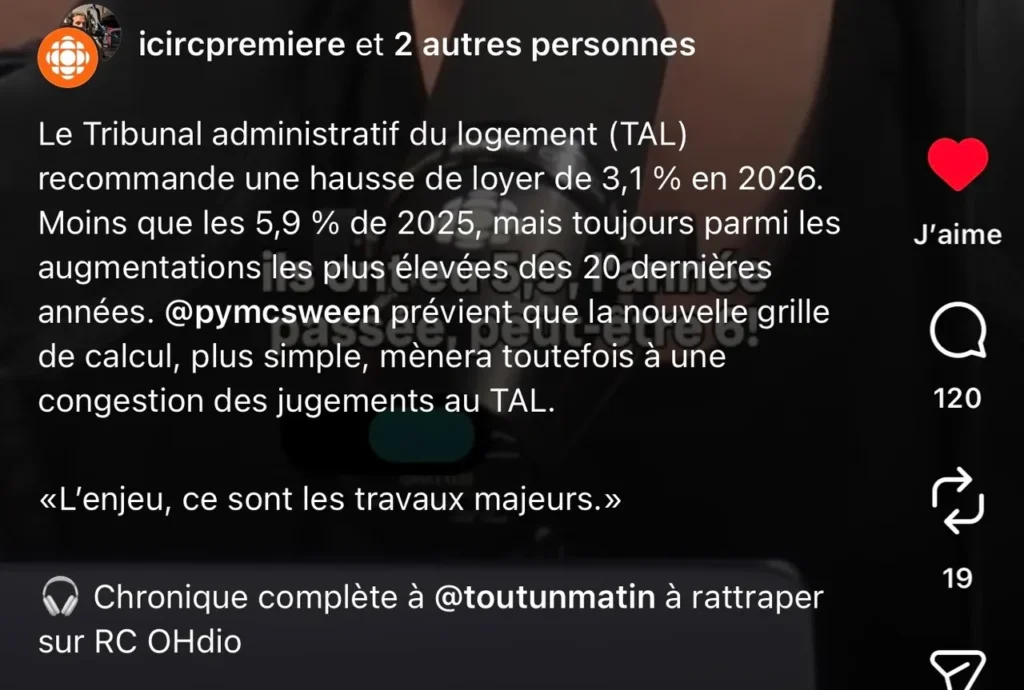
Toujours pas rapport Il faudrait une loi pour encadrer le prix des loyers et une autre pour limiter les profits réalisés sur la nourriture. Les marchés sont artificiellement gonflés pour répondre aux exigences de la fake pyramide. Un loyer ne devrait pas sortir du chapeau. On devrait au minimum pouvoir le relier à quelque chose de concret :
- Valeur municipale de l’immeuble ÷ nombre de logements ÷ superficie ;
- Taxes foncières ÷ nombre de logements ;
- Entretien réel.
Je n’écris pas une formule économique officielle. J’énumère simplement ce qui devrait servir de base. Une référence réelle, pas une bulle. Je me souviens avoir dit, durant la programmation, que cela ne serait pas contrôlable. Ça suit peut-être le principe décrit dans la chronique Le Vatican est assiégé.
Chronicle of the Shadow: Two Distinct References
Relevant or not I will be told that these are just figures. But there it is: the gross says one thing, the net says another. I find myself caught between these two distinct references. You will see that what I am complaining about—the injustice pointed out—concerns a change made to the SAAQ compensation pension. Whereas before I was given 90% of my salary, and that was not impossible, now a percentage is taken from that 90%, and then another adjustment is made. Added to this, this tax-free amount affects my taxable compensation for a second disability. The money received from the SAAQ is, from my point of view, heavily taxed.
« In this chronicle, the author denounces the fiscal and economic absurdity that weakens the citizen. He highlights the administrative ‘sleight of hand’ where a supposedly tax-free pension ends up impoverishing the recipient through tax bracket manipulation. By comparing the purchasing power of his father’s era to that of 2026, he points to the existence of artificial ‘bubbles’ created by the fake pyramid to inflate profits (housing, food). His plea for a return to ‘real references’—formulas based on municipal value and maintenance rather than speculation—is an attempt to bring the economy back to a human and concrete dimension, far from the delusions of grandeur that make housing inaccessible, even with a comfortable income. »
Chronicle of the Shadow: Two Distinct References
There was a time when one could buy a respectable house for $15,000. I was young or, in any case, it was shortly before my birth. My father used to tell me about it. I remember paying 10 cents to take the bus. I’m old, aren’t I?
Currently, I don’t know exactly how much I make. One pension is tax-free, two are taxed. The one that is tax-free still has deductions at the source! It cannot be explained rationally. It comes from the SAAQ. At the federal level, they don’t take this income source into account since it’s tax-free. At the provincial level, they change my tax bracket because they account for this tax-free income. It seems twisted to me. Let’s say it: this tax-free pension is heavily taxed.
Regardless, what I want to talk to you about is out of sync. If I think about my father’s story, I tell myself I would have a house as long as my pensions were proportional to the cost of living at the time. Currently, alone, with an income estimated at nearly $100,000, let’s suppose, I cannot buy a house. I am barely exaggerating.
In China, could I buy something? What year does the property price correspond to? The one my father referred to or 2026? This is far from a trivial question. If someone earns $1 an hour—I’m making up a scenario—but the house costs $15,000, can we really say that the Chinese person in question is underpaid? On what reference should I judge their financial situation?
Still not relevant There should be a law to regulate rent prices and another to limit profits made on food. Markets are artificially inflated to meet the requirements of the fake pyramid. Rent should not be pulled out of a hat. At the very least, it should be possible to link it to something concrete:
- Municipal value of the building ÷ number of units ÷ square footage;
- Property taxes ÷ number of units;
- Actual maintenance.
I am not writing an official economic formula. I am simply listing what should serve as a base. A real reference, not a bubble. I remember saying, during the programming, that this would not be controllable. It perhaps follows the principle described in the chronicle The Vatican is Under Siege.
Laisser un commentaire
Vous devez être connecté(e) pour rédiger un commentaire.