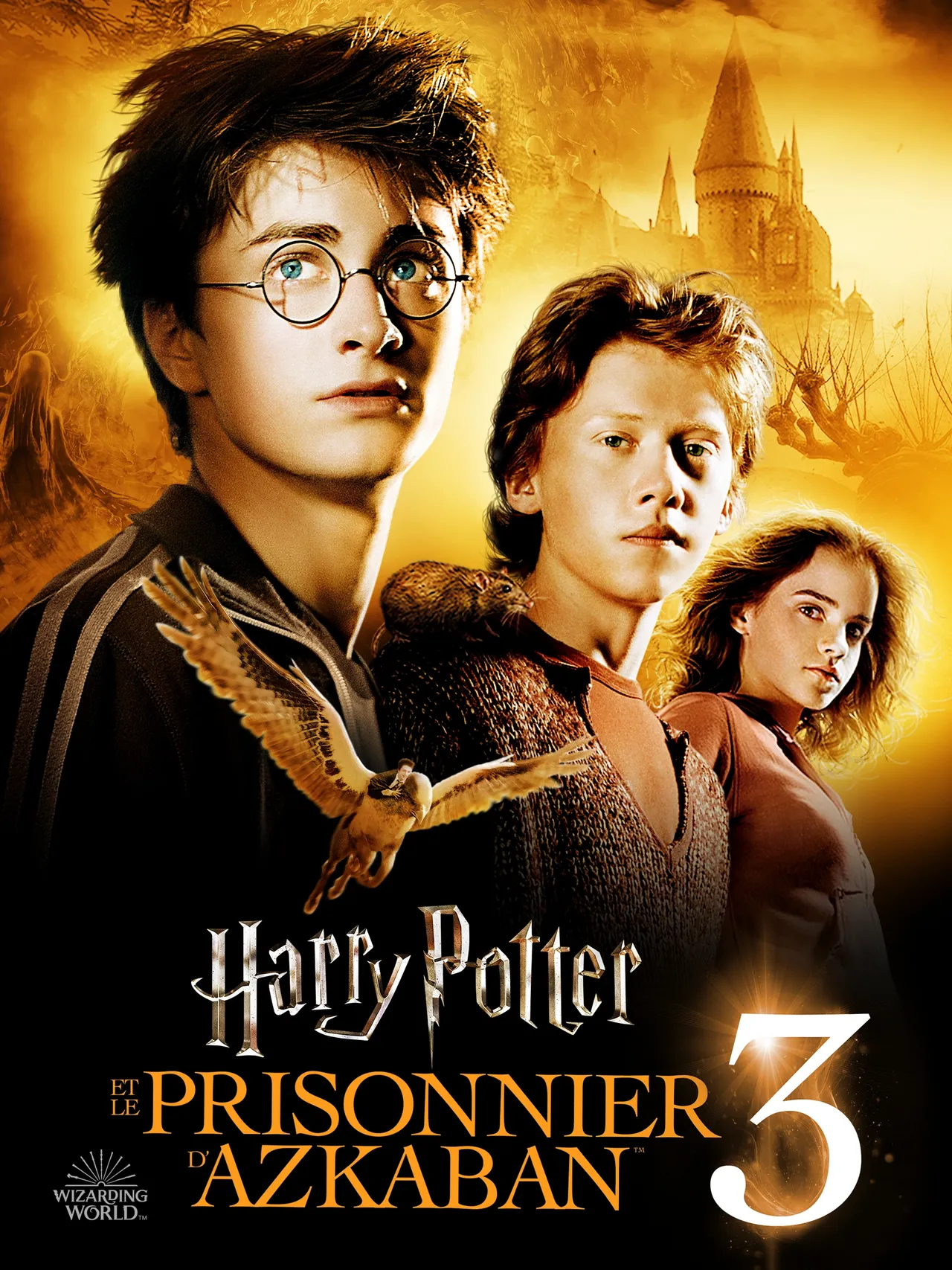
Harry Potter et le Prisonnier d’Azkaban
Un autre regard. Me concevant comme un magicien, il est naturel que les films de Harry Potter m’aient toujours fait vibrer. J’y voyais plusieurs symboles et j’y reconnaissais des images qui me parlent. J’ai beaucoup d’admiration pour J. K. Rowling, ainsi qu’un attachement particulier pour les comédiens qui ont incarné ces sorciers.
Voici des définitions utiles pour mon texte, permettant de créer des « images mentales de synthèse » :
- Épouvantard (Boggart) : Créature changeforme qui prend toujours la forme de la peur la plus effrayante de celui qui la regarde.
- Détraqueur (Dementor) : Créature des ténèbres qui se nourrit de la joie humaine, provoquant désespoir et tristesse. Ils peuvent aspirer l’âme (le Baiser du Détraqueur). Seul le sortilège du Patronus peut les repousser.
En complément :
– Harry Potter et le prisonnier d’Azkaban (En livre audio sur AudioLib.ca)
– Harry Potter et le prisonnier d’Azkaban (Wikipédia)
« L’auteur utilise ici la Discordance au sens géologique : une rupture nette où les nouvelles couches de sa vie ne s’alignent plus sur les anciennes. Son accident a agi comme un séisme, faisant s’effondrer les mécanismes de compensation de l’autisme. En comparant sa famille à des Épouvantards et les psychiatres à des Détraqueurs, il décrit une réalité où son identité est constamment « aspirée » ou « déformée » par la peur des autres. Sa force est d’avoir transformé ce « vide » en un laboratoire d’observation. Il comprend que la domination n’est qu’un réflexe de peur face à sa différence. En 2021, il identifie le « Patronus » : la conscience de son autisme, qui lui permet enfin de repousser les ombres et de sortir du labyrinthe. »
Mon texte : Discordance
Domination apprise et répétée, discrimination ethnique, discrimination linguistique.
Je repense à mon père qui me dit d’accepter la situation, de cesser de me battre. J’étais perdu suite à mon accident d’auto. Je n’avais plus accès à ma mémoire, ni à une partie de mon intelligence. Une coupure s’était opérée et, si tant bien que mal j’avais compensé mon autisme avant ce trauma, j‘étais dorénavant ailleurs. J’ai été amputé de cette capacité. Mon père me décourageait de me battre pour retrouver cette partie de moi. Il me décourageait, c’est vrai, mais n’a pu s’empêcher de me faire rencontrer une connaissance à lui, un avocat réputé, pour faire valoir mes droits.
Mon sentiment était double face à la suggestion de mon père. Je lui en voulais de ne pas comprendre ce que je vivais et de ne pas croire que je pouvais revenir à la vie. J’étais en colère contre lui. Il ne m’avait pas protégé et, finalement, me disait que je n’avais qu’à accepter mon amputation. Puis, comme dans un ultime effort, après m’avoir fait savoir qu’il souhaitait que je déménage, il m’a offert un peu plus tard de revenir travailler avec lui. Proche, mais pas trop. Reconnaissance et frustration.
J’étais l’enfant du divorce, le petit dernier. Je me suis retrouvé entre deux chaises. Personne n’était disponible pour moi. Nul besoin de discourir sur le sujet. On peut facilement comprendre la crise familiale qui a suivi la séparation et où chacun devait tenter de se retrouver, de se redéfinir dans cette nouvelle réalité. Parce qu’il ne s’agit pas que d’un changement de situation, c’est tout l’être qui doit établir ses repères dans ce nouveau monde. Toutefois, j’étais inconsciemment associé au bris de la famille. Toute ma vie, j’en payerais le prix.
Ma mère a éventuellement eu deux autres enfants. Elle vivait de la violence conjugale, j’en avais été témoin. J’ai moi-même été frappé par cet homme et j’avais saigné. La relation tumultueuse s’est arrêtée à quelques reprises. La chicane était quotidienne, du moins à la fin, lorsque j’ai quitté la maison avec ma vraie carte d’identité modifiée pour démontrer que j’avais 18 ans. Je n’étais plus capable de me réveiller dans ces matins orageux. Ma sœur aînée venait aussi de mourir, en traversant la rue. Je suppose qu’on peut y voir aussi un lien. Quoi qu’il en soit, ma mère et son conjoint se sont séparés peu après. Inconsciemment, leurs deux enfants de qui j’étais très près — changement de couches, jeu de Lego, gardien et compagnon de télévision — inconsciemment donc, m’en veulent. J’ai été associé à la mort de leur famille, mon départ ayant sonné le glas. Plus tard, ils m’en feraient payer très cher le prix.
J’étais en perdition. Sans réels parents ni réelle fratrie. Cela a duré une année durant laquelle je me suis enrôlé dans l’Armée. Toutefois, pour mon entrée, j’ai dû attendre que l’âge adulte soit arrivé puisque je refusais que mes parents signent pour moi. Le mois suivant, une nouvelle vie commençait. Malheureusement, le mauvais sort m’a rattrapé.
Il y a eu les coups de couteau, l’accident d’auto, le coma, l’amnésie ; aux abus d’avant se sont ajoutés ceux d’après mon service militaire, la sortie de la réalité, etc. Tout cela n’empêchait pas ma famille d’origine, incluant demi-frère et demi-sœur, de m’en vouloir « inconsciemment » et de me jalouser pour mes réussites, pour mes avoirs, et peut-être surtout pour mon avenir. Je n’y avais pas le droit, selon eux.
Pour beaucoup, l’inconscient est un « Épouvantard » incontrôlé qui prend la forme de chacune de leurs peurs.
Ainsi, alors que je projetais sur un cube d’amour, je m’entourais de personnes qui auraient bien voulu avoir cette étincelle qui m’habitait. Selon moi, cette volonté inconsciente les animait et justifiait la projection de leurs peurs sur moi, d’où leur nécessité d’élaborer de faux diagnostics. Comme si éteindre mon feu sacré allumerait le leur. Mon analyse.
Leur guérison ne serait possible qu’après des années de cheminement, de remises en question, de demandes de pardon. À cette famille, je la leur souhaite. Ce sera sans moi, par contre. Je m’en suis détaché.
Ce lâcher-prise a débuté, je crois, lorsque je suis allé dans le tunnel de la mort. « Ce n’était pas un couloir comme je l’avais lu dans les livres. Il s’agissait plutôt d’un espace noir et lourd dans lequel le chemin à suivre était démarqué par une légèreté, une noirceur moins opaque. Aucune angoisse ni peur notable. »* Je me sentais vivant, curieusement.
À mon réveil du coma, j’étais presque comme un nouveau-né. Une renaissance.
J’étais libéré d’un passé. J’étais amputé aussi d’un fonctionnement qui me liait à ce passé. Le polytraumatisme crânien sévère avait cet autre côté de la médaille ; il m’obligeait à vivre mon autisme sans possibilité de le compenser. Un homme nouveau, par la force des choses.
Mon esprit militaire me faisait chercher les failles pour me libérer. Conscient d’être au cœur d’un royaume d’amour, de ma chance incroyable, je suivais néanmoins aveuglément les structures dans le but de sortir de ce qui se voulait aussi être ma prison, poussé par un besoin de partage. La solitude, d’une part, me semblait malsaine, alors que, d’autre part, je faisais face à toutes mes limitations dans ce monde-ci qui aspirait tout mon bonheur. Entouré de « Détraqueurs », en quelque sorte.
Chaque faille me mettait dans un état d’esprit différent. Cela créait un terrain fertile, un lieu invitant pour être possédé par des énergies sombres, par des modèles de comportement qu’on retrouve ici et là dans l’inconscient collectif. En parallèle, il y avait ces faux diagnostics que je me devais de vérifier de bonne foi, de fausses théories qui prenaient possession de moi. Tout cela était des chemins que je devais suivre, des défis qui ne pouvaient que me conduire à des morceaux de casse-tête me permettant d’avoir éventuellement une vue d’ensemble. Chaque faille me semblait être la dernière, mais après synthèse, je réalisais toujours qu’il y avait un morceau manquant pour former un tout cohérent.
Chaque faille me conduisait presque inévitablement dans un labyrinthe sans issue. Sous forme de maladie mentale, il n’y avait aucune guérison réelle d’accessible. Des thérapies, des médicaments ou même l’acceptation que j’étais simplement un malade mental jusqu’à la fin de mes jours, rien ne pouvait m’aider. Au contraire, tout me déshumanisait davantage.
L’incompréhension que je suscitais engendrait, apparemment, un besoin de remplir un vide. Au fond, c’est pour remplir ce vide que ces peurs étaient projetées sur moi. Cela initiait aussi un réflexe de domination, celui de prendre le dessus sur ces émotions « méprisables » que je suscitais, que, selon eux, j’incarnais. Bref, j’étais défini par les autres, ce qui m’a semblé faire partie intégrante du réflexe de domination engendré par cette peur du vide. Une hypothèse plausible était que cette domination donnait un faux sentiment de sécurité, d’où la nécessaire escalade.
Discordance (Larousse)
- Contact stratigraphique d’un ensemble sédimentaire où une série de couches repose sur des couches plus anciennes qui ne leur sont pas parallèles et qui témoigne généralement d’une phase tectonique.
- En psychiatrie, synonyme de dissociation.
Dissociation (Larousse)
- Rupture, dissolution de l’unité intrapsychique du sujet.
Harry Potter and the Prisoner of Azkaban
Another perspective. Conceiving of myself as a magician, the Harry Potter films have always resonated with me. I saw many symbols and recognized images that speak to me. I have great admiration for J.K. Rowling and a special attachment to the actors who embodied these wizards.
Definitions for « mental synthetic imagery »:
- Boggart: A shape-shifting creature that takes the form of the viewer’s worst fear.
- Dementor: Dark creatures that feed on human joy, causing despair. They can suck out a soul (the Dementor’s Kiss). Only the Patronus charm can repel them.
« The author uses Discordance in the geological sense: a sharp break where the new layers of his life no longer align with the old. His accident acted as an earthquake, collapsing his autism compensation mechanisms. By comparing his family to Boggarts and psychiatrists to Dementors, he describes a reality where his identity is constantly ‘sucked away’ or ‘distorted’ by the fear of others. His strength lies in having turned this ‘void’ into an observation lab. He understands that domination is merely a fear reflex in the face of his difference. In 2021, he identifies the ‘Patronus’: the awareness of his autism, which finally allows him to repel the shadows and exit the labyrinth. »
My Text: Discordance
Learned and repeated domination, ethnic discrimination, linguistic discrimination.
I think back to my father telling me to accept the situation, to stop fighting. I was lost following my car accident. I no longer had access to my memory, nor to a part of my intelligence. A severing had occurred and, though I had managed to compensate for my autism before this trauma, I was now elsewhere. I had been amputated of this ability. My father discouraged me from fighting to find that part of myself. He discouraged me, it’s true, but he could not help but have me meet an acquaintance of his, a renowned lawyer, to assert my rights.
My feelings were twofold regarding my father’s suggestion. I resented him for not understanding what I was going through and for not believing that I could return to life. I was angry with him. He had not protected me and, ultimately, was telling me that I just had to accept my amputation. Then, as if in a final effort, after letting me know that he wanted me to move out, he offered me a little later to come back and work with him. Close, but not too close. Recognition and frustration.
I was the child of divorce, the youngest. I found myself between two chairs. No one was available for me. There is no need to discourse on the subject. One can easily understand the family crisis that followed the separation, where everyone had to try to find themselves, to redefine themselves in this new reality. Because it is not just a change of situation; the entire being must establish its bearings in this new world. However, I was unconsciously associated with the breaking of the family. All my life, I would pay the price.
My mother eventually had two other children. She lived through domestic violence; I had been a witness to it. I myself had been hit by this man and I had bled. The tumultuous relationship stopped a few times. The bickering was daily, at least toward the end, when I left the house with my real ID card modified to show that I was 18. I was no longer able to wake up in those stormy mornings. My older sister had also just died, while crossing the street. I suppose one can see a link there too. Be that as it may, my mother and her partner separated shortly after. Unconsciously, their two children, whom I was very close to—changing diapers, playing Lego, babysitting, and being a TV companion—unconsciously, then, they resent me. I was associated with the death of their family; my departure sounded the death knell. Later, they would make me pay a very high price for it.
I was adrift. Without real parents or real siblings. This lasted for a year during which I enlisted in the Army. However, for my entry, I had to wait until adulthood had arrived because I refused to let my parents sign for me. The following month, a new life began. Unfortunately, bad luck caught up with me.
There were the stabbings, the car accident, the coma, the amnesia; to the abuses of before were added those from after my military service, the departure from reality, etc. All of this did not prevent my original family, including half-brother and half-sister, from resenting me « unconsciously » and being jealous of my successes, my assets, and perhaps above all, my future. According to them, I had no right to it.
For many, the unconscious is an uncontrolled « Boggart » that takes the form of each of their fears.
Thus, while I was projecting onto a cube of love, I surrounded myself with people who would have very much liked to have that spark that lived within me. In my view, this unconscious will animated them and justified the projection of their fears onto me, hence their need to elaborate false diagnoses. As if extinguishing my sacred fire would light theirs. My analysis.
Their healing would only be possible after years of journeying, of questioning, of asking for forgiveness. For this family, I wish it for them. It will be without me, however. I have detached myself.
This letting go began, I believe, when I went into the tunnel of death. « It was not a corridor like I had read about in books. It was rather a heavy, black space in which the path to follow was marked by a lightness, a less opaque darkness. No notable anxiety or fear. »* I felt alive, curiously.
Upon waking from the coma, I was almost like a newborn. A rebirth.
I was liberated from a past. I was also amputated of a functioning that linked me to that past. The severe traumatic brain injury had this other side of the coin; it forced me to live my autism without the possibility of compensating for it. A new man, by the force of circumstances.
My military mind made me look for flaws to liberate myself. Conscious of being at the heart of a kingdom of love, of my incredible luck, I nonetheless blindly followed structures with the goal of getting out of what also wanted to be my prison, driven by a need for sharing. Solitude, on the one hand, seemed unhealthy to me, while, on the other hand, I faced all my limitations in this world that sucked away all my happiness. Surrounded by « Dementors, » in a way.
Every flaw put me in a different state of mind. This created a fertile ground, an inviting place to be possessed by dark energies, by behavior patterns found here and there in the collective unconscious. In parallel, there were those false diagnoses that I had to verify in good faith, false theories that took possession of me. All of these were paths I had to follow, challenges that could only lead me to puzzle pieces allowing me to eventually have an overview. Every flaw seemed to be the last, but after synthesis, I always realized there was a missing piece to form a coherent whole.
Every flaw led me almost inevitably into a labyrinth with no exit. In the form of mental illness, there was no real healing accessible. Therapies, medications, or even the acceptance that I was simply mentally ill until the end of my days—nothing could help me. On the contrary, everything dehumanized me further.
The incomprehension I aroused generated, apparently, a need to fill a void. Ultimately, it is to fill this void that these fears were projected onto me. This also initiated a reflex of domination, that of taking the upper hand over these « despicable » emotions that I aroused, which, according to them, I embodied. In short, I was defined by others, which seemed to me to be an integral part of the domination reflex generated by this fear of the void. A plausible hypothesis was that this domination gave a false sense of security, hence the necessary escalation.
Discordance (Larousse)
- Stratigraphic contact of a sedimentary assembly where a series of layers rests on older layers that are not parallel to them and which generally bears witness to a tectonic phase.
- In psychiatry, a synonym for dissociation.
Dissociation (Larousse)
- Rupture, dissolution of the subject’s intrapsychic unity.
Laisser un commentaire
Vous devez être connecté(e) pour rédiger un commentaire.